
What to look for in a parking LPR system before you buy
TL;DR
A parking license plate recognition (LPR) system should do more than read plates. Sighthound ALPR+ reads plates from images and RTSP video and adds make, model, color, and generation (MMCG) recognition, so a vehicle is still identified when a plate is muddy or missing. Before you buy, weigh recognition accuracy, camera and lighting requirements, permit and overstay workflows, REST API integration, and whether the system runs on-premises so plate data stays under your control.
“This article is for informational purposes and is not legal advice. Consult your organization's counsel for guidance specific to your jurisdiction and workflow.”
Key takeaways
A parking LPR system should pair plate reads with vehicle attributes, because a plate alone is unreliable when it's obscured, damaged, or missing.
Sighthound ALPR+ adds MMCG recognition and uses fuzzy matching to authorize access when a plate is only partly readable.
Recognition accuracy depends on camera placement, lens, lighting, exposure, and stream settings, so evaluate the camera plan, not just the software.
ALPR+ works with existing fixed and dashcam cameras over RTSP and ONVIF, which avoids a rip-and-replace project.
A Docker container with a REST API and JSON output lets ALPR+ feed permit, payment, access-control, and analytics systems.
On-premises and edge deployment on the Sighthound Compute Node keeps plate and MMCG data inside your network.
Ask each vendor what they don't provide: named integrations, certifications, data-retention windows, and published pricing.
What does a parking LPR system do?
A parking LPR system reads license plates from camera images or live video and turns each read into structured data your other systems can act on. Automatic License Plate Recognition (ALPR) is the engine behind it.
The better systems separate two jobs. Detection tells you whether a vehicle entered or left and whether a space is occupied. Identification tells you which vehicle, by plate and by attributes.
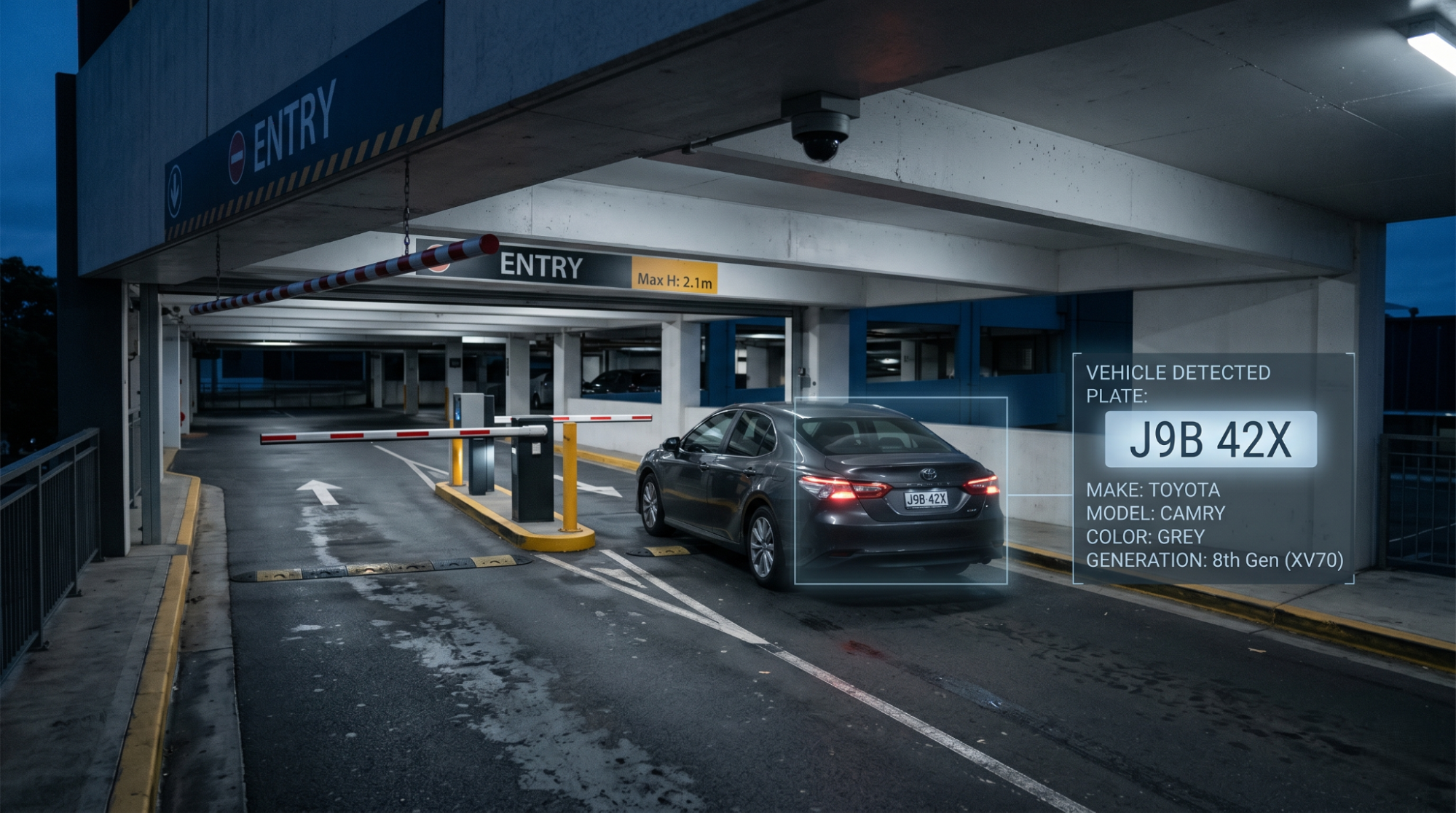
Parking entry camera reading a plate with a Sighthound ALPR+ make, model, color, and generation overlay.
Sighthound ALPR+ does both. It reads plates from images and live RTSP streams and returns structured JSON for each event. It also adds MMCG recognition, so you get the make, model, color, and generation of the vehicle, not just the tag. Plate region coverage includes US states, Canadian provinces and territories, and European Union countries.
Why a plate read alone falls short
Plates go bad in the real world. They get covered by mud or snow, bent, faded, or swapped for a specialty design the reader hasn't seen. Accuracy also shifts with sensor quality, camera placement, exposure, motion blur, and lighting.
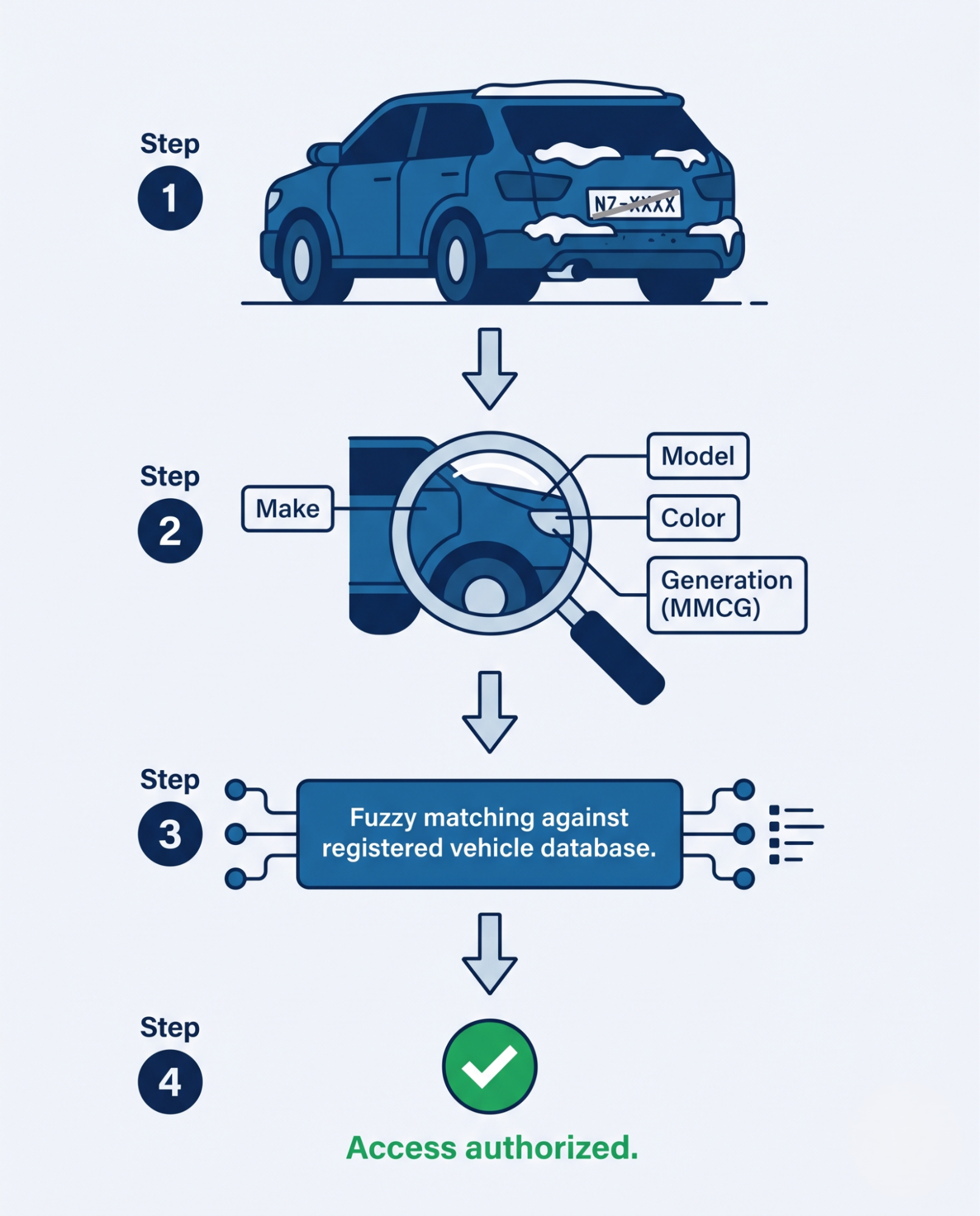
Infographic showing MMCG fuzzy matching authorizing access for a vehicle with a partially obscured license plate.
ALPR+ uses a deep neural network platform rather than the older OCR methods that struggle with these conditions. When a plate is only partly readable, fuzzy matching cross-references the vehicle's MMCG profile against a registered-vehicle database to still authorize access at the gate.
Recognition still has hard cases worth asking about: M, W, and N confusion, I versus 1, O versus zero, specialty-plate graphics, and brand-new plate designs. ALPR+ retraining for new designs is ongoing, so ask any vendor how they handle plate changes in your region.
What camera setup and night performance should you require?
Camera compatibility
ALPR+ is a recognition engine, not a camera. It runs against the fixed and dashcam cameras you already have, so you don't need to rip out hardware to deploy it.
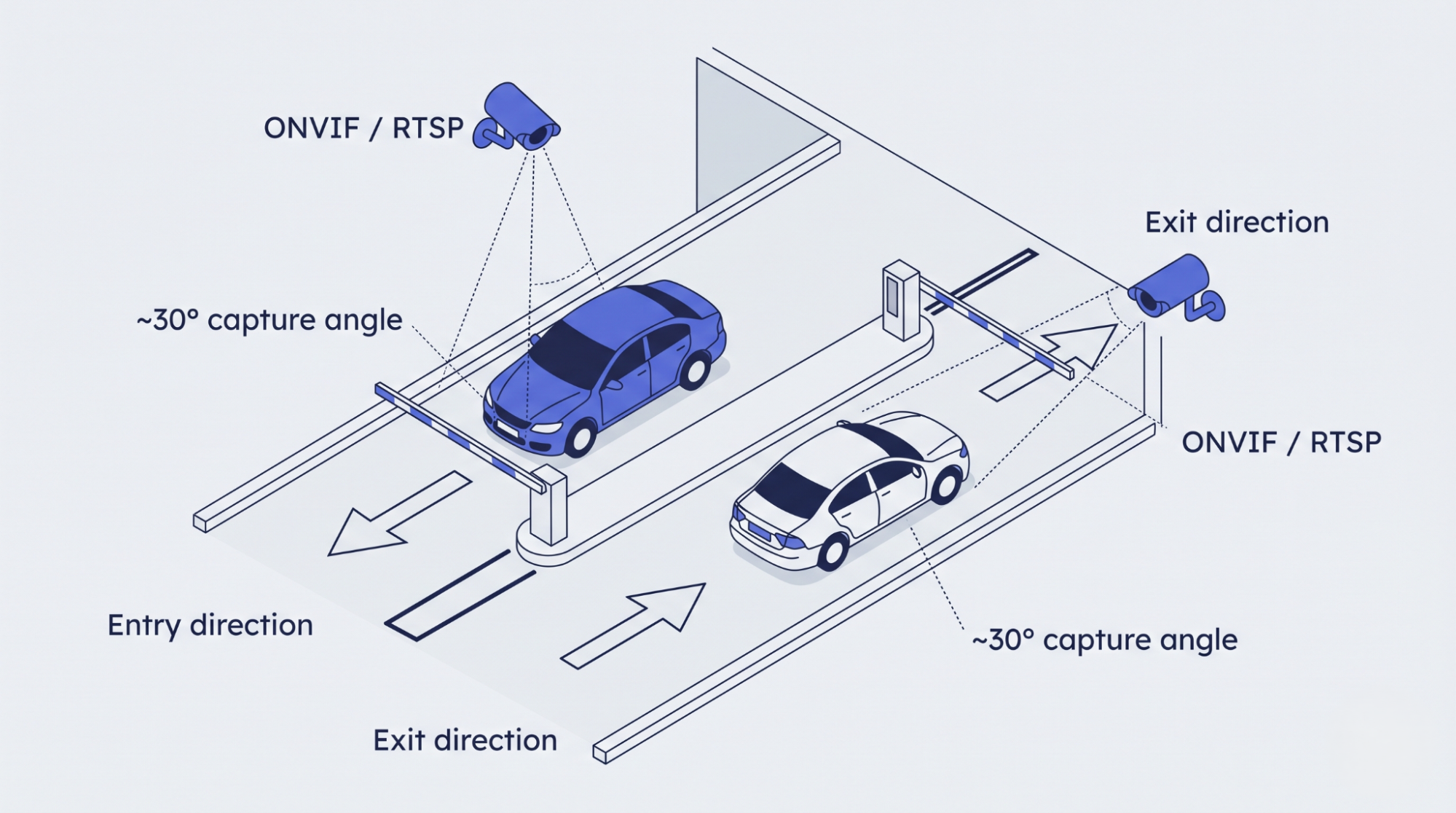
Diagram showing a 30-degree license-plate capture angle for entry and exit cameras at a parking lane.
Set the basics correctly. Cameras should support ONVIF and RTSP. The recommended stream is 1080p at 30 FPS using H.264 or H.265 has caused processing failures, so stay on H.264. Run two streams per camera, one for recording and one for ALPR+, capture the plate within roughly a 30-degree angle, and position entry and exit cameras so direction of travel is clear.
Night performance
Sensors need genuine low-light performance, high dynamic range, and IR capability. Pair that with IR illumination, the right shutter speed, and preprocessing such as dewarping and contrast enhancement, and read rates after dark hold up.
Which deployment model fits: on-prem, cloud, or edge?
Deployment flexibility is a buying criterion in its own right. ALPR+ runs on-prem, in a private cloud, or at the edge, with no forced architecture.
On-prem and private cloud
For compliance-sensitive and security-sensitive sites, ALPR+ runs fully inside your own environment, with no data leaving your infrastructure. On-prem and air-gapped operation supports GDPR-sensitive deployments.
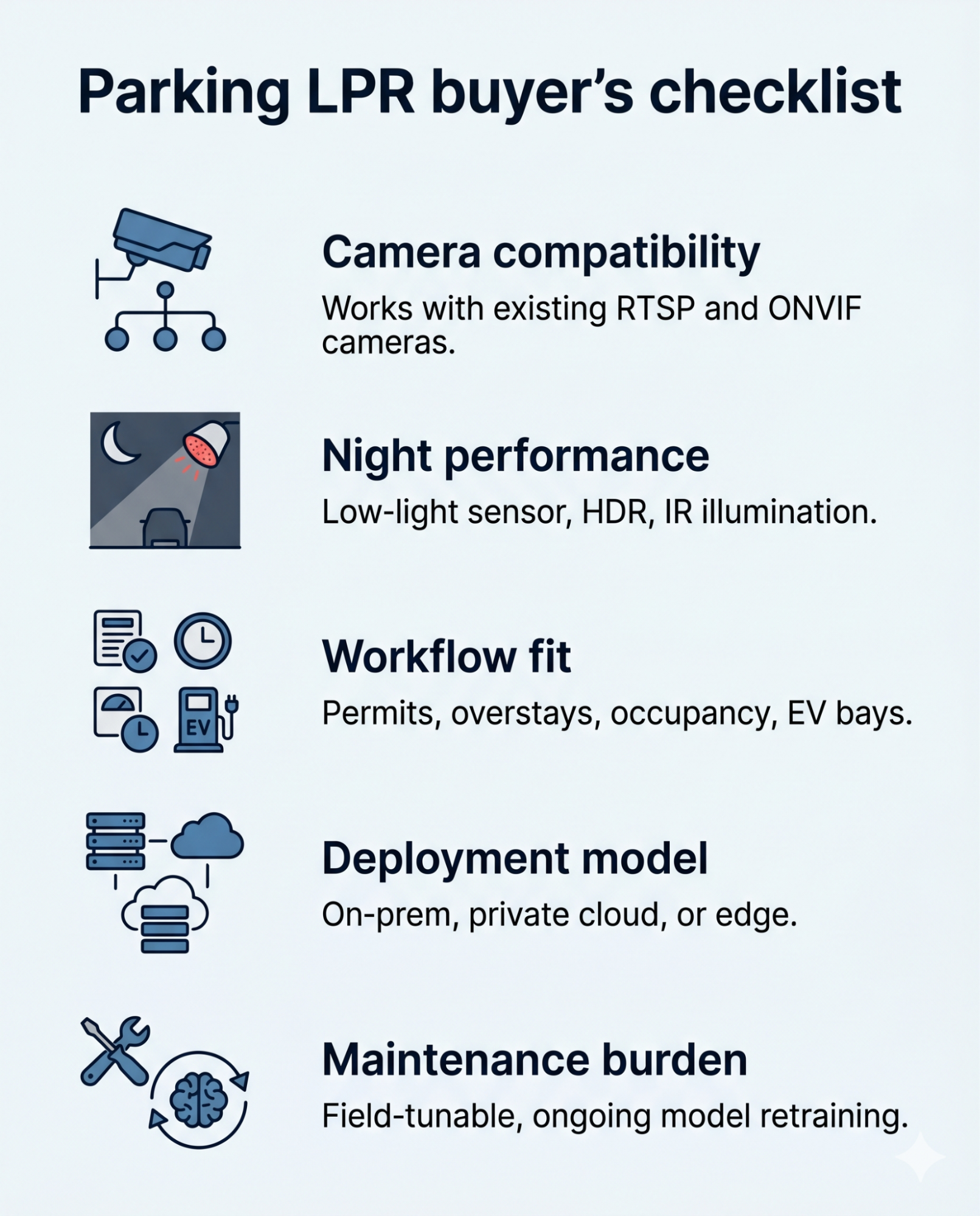
Infographic listing five buyer's-checklist criteria for a parking LPR system: cameras, night, workflow, deployment, maintenance.
Privacy rules apply to plate data tied to people. In the EU, the GDPR governs that data. In the US, state regimes such as California's CCPA can apply, and several states regulate ALPR data retention directly, so confirm your state's rules before you set a retention policy.
Edge with the Compute Node
The Sighthound Compute Node runs ALPR+ and MMCG on-device at the capture point, fully offline, with no cloud routing. It pairs with standard IP cameras, is IP67-rugged, and handles up to four camera streams. Every transaction is timestamped for an automatic audit trail.
What about integration and ongoing maintenance?
Integration surface
ALPR+ ships as a Docker container with a REST API on Windows and Linux, and returns structured JSON for downstream systems. It supports RabbitMQ workflows, Python-based filtering, and Zapier for third-party apps.
For video management, it integrates over ONVIF metadata, RTSP overlays, webhooks, and event APIs, and works with platforms such as Milestone or Genetec without replacing your cameras or storage. It can trigger gates and plate-to-payment flows without relying on the cloud. Developer documentation can be read at docs.sighthound.com.
Maintenance burden
Working with existing cameras keeps the hardware project small. Tuning parameters such as stabilization delay and minimum confidence thresholds are field-adjustable per site. Model retraining for new plate designs is ongoing, and the same software covers cloud and on-prem, so you maintain one integration path.
Be precise about scope. ALPR parking deployment does not replace physical gates or barriers, and it isn't a full case-management or citation system; it integrates with those. And confirm what a vendor hasn't published: named gate, payment, and access-control integrations, certifications such as SOC 2 or ISO 27001, formal retention windows, and parking pricing tiers.
How Sighthound ALPR+ fits these criteria
Run your shortlist against the same five questions, camera compatibility, night performance, workflow fit, deployment model, and maintenance burden.
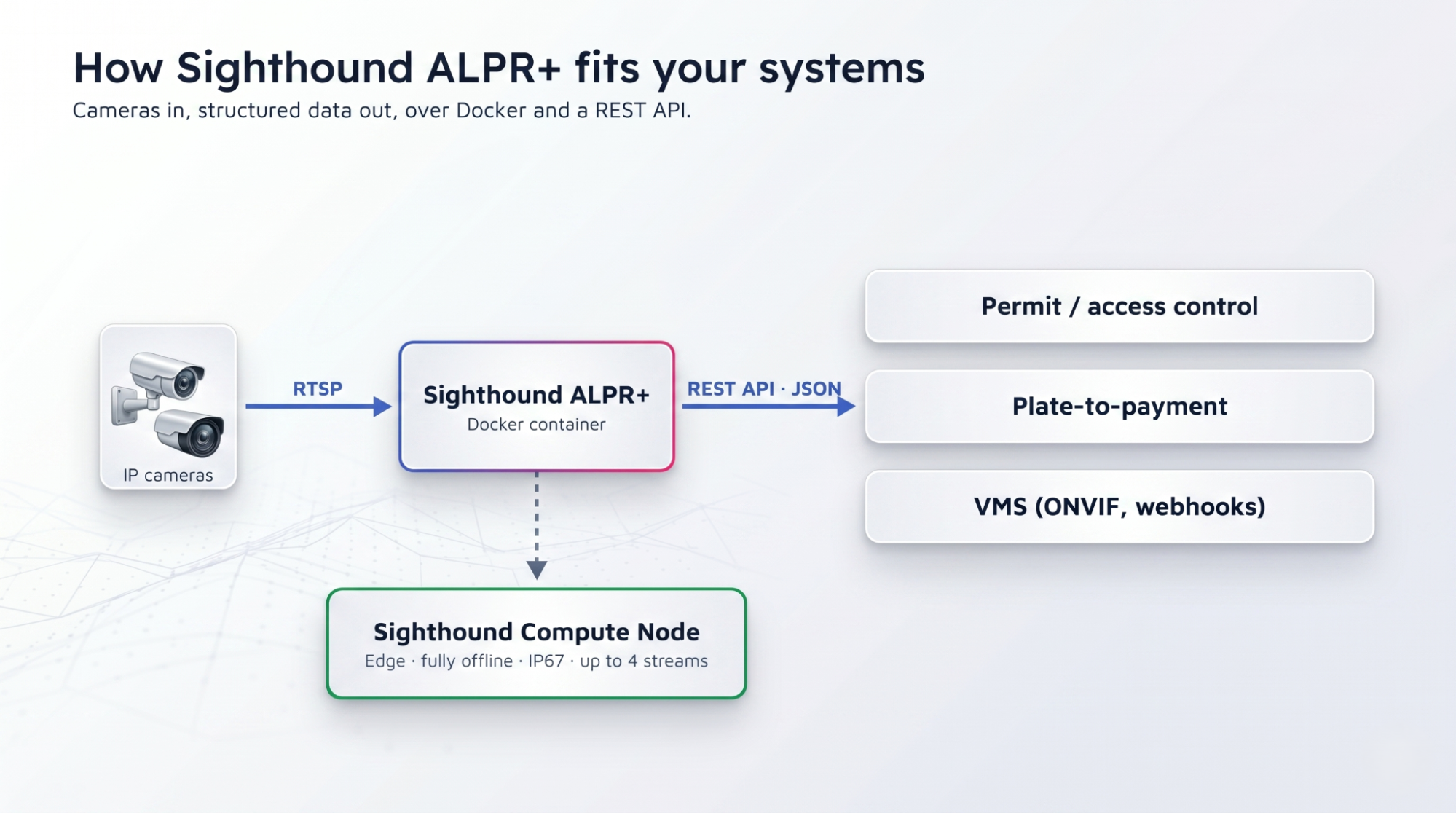
Cameras feeding Sighthound ALPR+ with REST API output to permit, payment, and VMS systems.
Sighthound ALPR+ answers them with MMCG plus fuzzy matching for obscured plates, RTSP and ONVIF integration with your existing cameras, a Docker and REST API path with JSON output, and on-prem or Compute Node deployment that keeps plate and MMCG data in your network.
Want to see AI-powered LPR in action?Test Drive ALPR+ now with our sample images.
For business opportunities, explore our Partner Program today.
Read next: How AI-Powered Mobile LPR Helps Recover Stolen Vehicles Faster
FAQs
-
No. It integrates with your existing fixed and dashcam infrastructure over RTSP and ONVIF.
-
Yes. On-prem and edge deployment on the Sighthound Compute Node run fully offline, with no cloud routing.
-
It runs as a Docker container with a REST API and JSON output, and integrates with VMS platforms, gates, and payment systems.
-
On-prem and edge processing keep plate and MMCG data in your network, and every transaction is timestamped for an audit trail.