
Using ALPR to Track or Monitor Fleet Entry Without Manual Logs
It is the Monday morning rush at your distribution center. A queue of delivery trucks is idling at the gate, engines burning fuel while drivers wait for a guard to manually scribble down license plate numbers on a clipboard. In the rain, digits get transposed, entry times are estimated, and the "security log" becomes an unreadable, unsearchable paper trail.
For logistics and facility managers, manual gate entry is more than an annoyance; it is a silent bottleneck costing thousands in wasted time and blind spots.
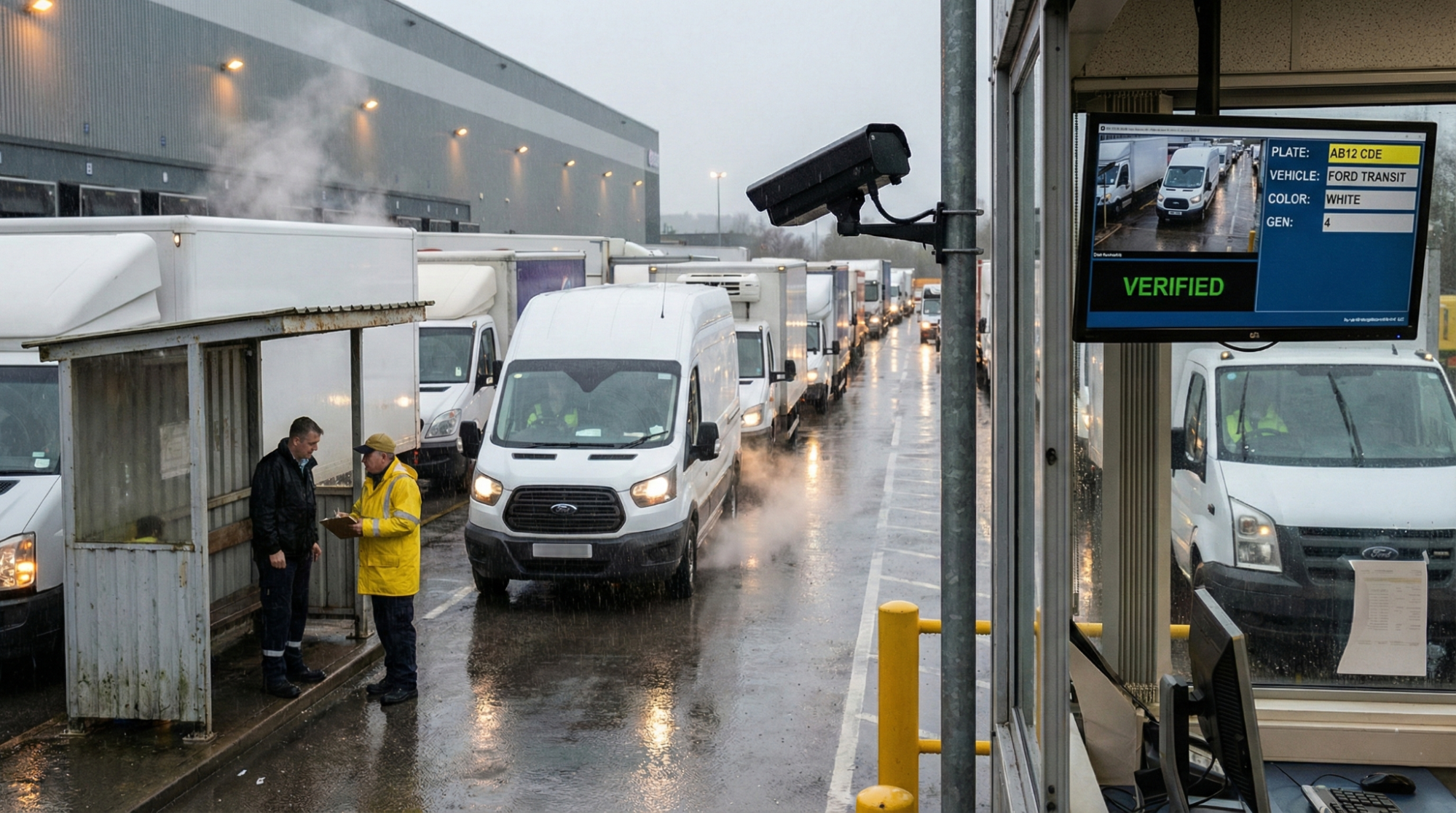
Security gate at a busy logistics distribution center featuring an ANPR screen displaying 'Verified' status for a white Ford Transit van, with a security guard checking paperwork in rainy weather
While Global Positioning Systems (GPS) track vehicles on the road, the gate often remains a gap in supply chain visibility. The solution is to move from analog clipboards to digital cameras. Automatic License Plate Recognition (ALPR) has grown beyond simple police scanners into a business tool that can authenticate, log, and verify fleet vehicles in milliseconds.
But true security requires more than reading text. It requires Vehicle Recognition the ability to confirm that the plate XYZ-123 belongs to the White Ford Transit entering your yard, not a different vehicle wearing stolen tags.
The Hidden Costs of the "Clipboard Method"
To understand the value of ALPR+, we must first look at the cost of current methods. Many depots still rely on a guard, a pen, and a clipboard. On the surface, this seems cheap; you already pay the guard, so why not have them write down plates?
However, when you calculate the total operational expense, manual logging is one of the most costly security protocols.
1. The Cost of Dwell Time
In logistics, time is inventory. Every minute a truck sits idling at a gate is a minute it is not moving.
The Math of Idling: If a guard takes 90 seconds to stop a truck, walk around to check the plate, speak to the driver, and open the gate, and you process 50 trucks a day, that is 75 minutes of lost productivity daily.
Annual Impact: Over a year, that equals 300+ hours of fleet time wasted just sitting at your own front door.
Fuel Burn: Idling heavy-duty trucks burn approximately 0.8 gallons of fuel per hour. The cost isn't just time; it is diesel.
2. Data Integrity
Humans struggle to transcribe random alphanumeric strings correctly.
Error Rates: Studies in data entry show a human error rate of roughly 1% to 4% for transcription tasks. In a busy rainstorm or under poor lighting, a guard’s error rate can rise to 10%.
The Ghost Vehicle: If a guard writes down O (the letter) instead of 0 (the number), that record becomes useless. When you try to audit which truck entered at 10:00 AM, the search returns zero results. You have a "ghost vehicle" inside your perimeter.
3. Plate Swapping
A clipboard log assumes that the license plate attached to the vehicle is valid. A guard rarely checks if the plate matches the vehicle’s registration document during a quick entry.
The Threat: A bad actor can steal a valid fleet plate, attach it to a personal sedan, and drive past a guard who is looking for the plate number, not the vehicle context.
The Result: Your secure facility is breached because the verification method was too simple.
Why MMCG Matters for Fleets
For a fleet manager, the license plate is only half the story. The MMCG data provides the context needed for true security.
| Feature | Standard ALPR | Sighthound ALPR+ |
|---|---|---|
| Primary Data | Plate Number (String) | Plate Number + Confidence Score |
| Secondary Data | None | Make, Model, Color, Generation |
| Verification | Matches string to list. | Matches string AND visual appearance. |
| Security Check | "Is this plate allowed?" | "Is this plate allowed, and is it on the correct vehicle?" |
| Ambiguity Handling | Fails on muddy plates. | Uses vehicle visual attributes to assist identification. |
Implementing the "Touchless Gate"
Moving from manual logs to a computer-controlled system requires a mix of hardware installation and software setup. Sighthound works on standard hardware, meaning you do not need to buy specific "black box" cameras. You can use standard IP cameras, provided they are set up correctly.
1. Camera Placement & Physics
The success of any computer vision system depends on the quality of the pixels it receives.
The "30-Degree Rule": For the best read rates, position the camera so that the angle between the lens and the license plate is no more than 30 degrees horizontally and vertically. Steeper angles distort the characters.
Choke Points: Install cameras at natural "choke points" where vehicles must slow down or stop ticket barriers, gates, or weigh stations.
Field of View (FoV): Ensure the plate occupies enough pixel density. A good rule is that the plate should be at least 100-150 pixels wide in the captured image for best accuracy.
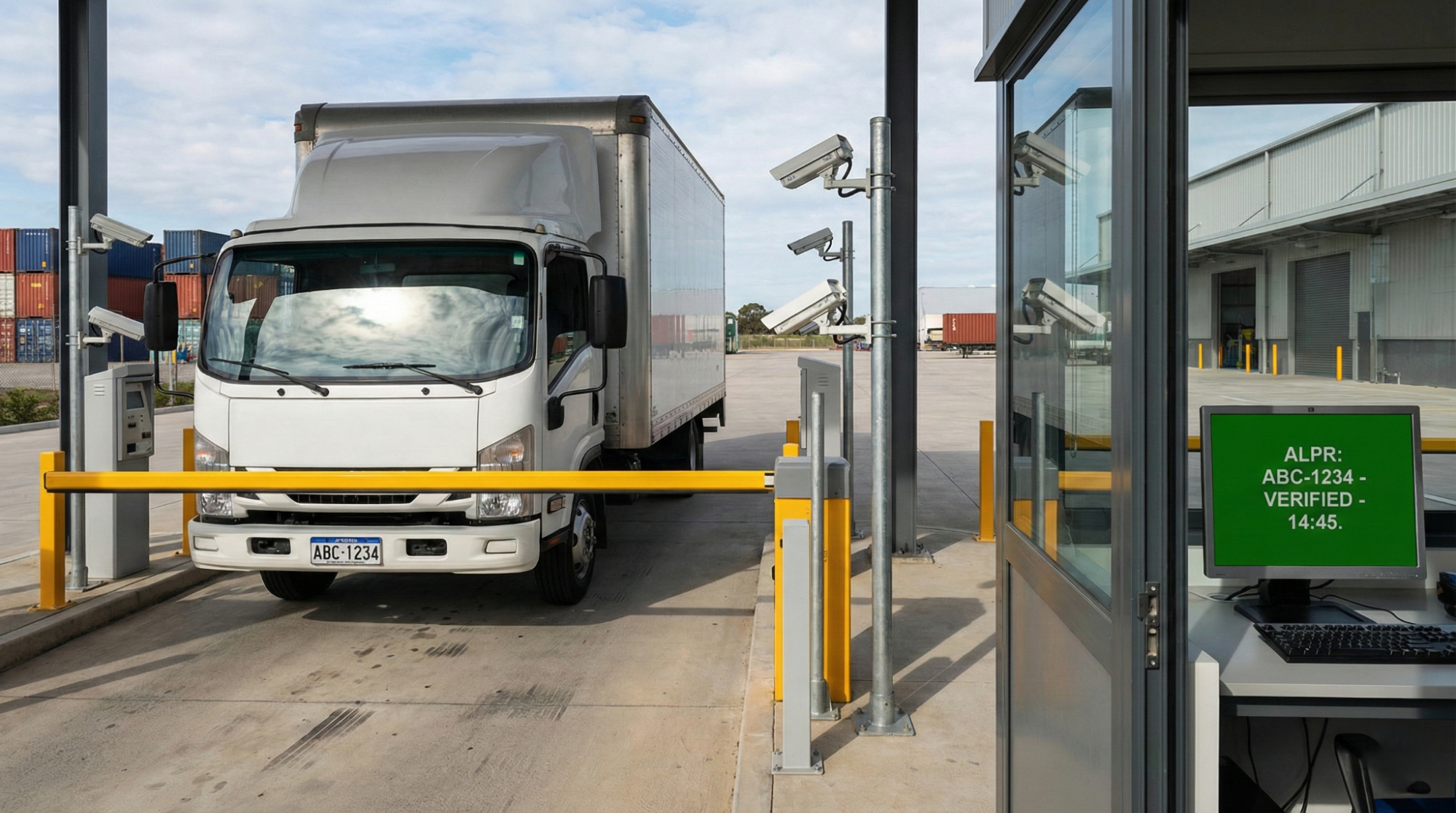
ALPR software interface on a security monitor confirming license plate verification for a delivery truck at an automated warehouse gate access point
2. Lighting the Scene
Cameras need light.
Daytime: Standard daylight is usually sufficient.
Nighttime: This is where most systems fail. You need Infrared (IR) illumination. Reflective license plates become very clear under IR light, making them easy to read even in total darkness. Ensure your cameras have built-in IR LEDs or install separate IR floodlights.
3. The Processing Architecture: Edge vs. Cloud
Sighthound ALPR+ is flexible. You can set it up based on your network needs.
Edge Deployment (On-Premise):
How it works: The software runs on a local server or a specialized device (like an NVIDIA Jetson) right at the guard shack.
Pros: Zero latency. Works even if the internet goes down. Uses less bandwidth (video stays local; only text data is sent out).
Best for: Secure sites with poor internet connectivity.
Cloud Deployment:
How it works: The camera sends images to the Sighthound Cloud API. The cloud processes the image and returns the JSON data.
Pros: No local servers to maintain. Easy to expand. Easy to update.
Best for: Sites with fast fiber internet and few IT staff members.
Integration for Developers
The real value of ALPR+ isn't just in reading the plate; it is in what you do with that data. Sighthound provides a developer-friendly API that outputs clean JSON (JavaScript Object Notation).
This is important because it allows your existing Fleet Management Software (FMS) or Enterprise Resource Planning (ERP) system to ingest the data without complex translation.
The Data Payload
When a truck passes the camera, Sighthound’s Vehicle Analytics engine generates structured JSON annotations describing the detected license plate and vehicle attributes. In SIO deployments, each camera or pipeline can be labeled with a sourceId so downstream systems know where the data originated.
Here is a conceptual look at what that data looks like:
JSON
{
  "sourceId": "Gate_North_Entry",

  "licenseplateAnnotations": [
    {
      "string": {
        "value": "FLT8821",
        "score": 0.98
      },
      "region": {
        "value": "Florida",
        "score": 0.81
      },
      "score": 0.92,
      "locale": "en-US",
      "description": "License plate"
    }
  ],

  "vehicleAnnotations": [
    {
      "make": {
        "value": "ford",
        "score": 0.94
      },
      "model": {
        "value": "f-150",
        "score": 0.91
      },
      "color": {
        "value": "white",
        "score": 0.93
      },
      "generation": {
        "value": {
          "start": 2015,
          "end": 2020
        },
        "score": 0.87
      },

      "licenseplate": {
        "$ref": "#/licenseplateAnnotations/0"
      },

      "score": 0.94,
      "locale": "en-US",
      "description": "Car"
    }
  ]
}
Running the Logic
Once this JSON data is ingested into your system, simple automation rules can replace manual decision-making at the gate.
1. Whitelist Check
Logic
Does the detected plate string exist in the authorized_vehicles database, and is the recognition score above the acceptance threshold?
Action
If yes, send a signal to open the gate.
If not, trigger a red light and alert security.
In production systems, automated access is typically limited to high-confidence reads to prevent false openings caused by partial or unclear plates.
2. Visual Audit Check
Logic
The fleet database indicates that plate FLT8821 belongs to a white Ford F-150.
The latest vehicle annotation reports a different make or model.
Action
Do not grant automatic access.
Flag the event for review as a possible mismatch.
Because Sighthound provides independent confidence scores for make, model, color, and generation, systems can distinguish between minor variations and meaningful discrepancies, helping detect potential plate swapping or misregistration.
3. Dwell Time Calculation
Logic
Match an “entry” detection with a later “exit” detection for the same plate.
Action
dwell_time = exit_timestamp – entry_timestamp
If dwell time exceeds four hours, notify the dock manager.
Sighthound supplies the identification data. Your application defines what constitutes an entry and exit event, typically using two cameras labeled with different sourceId values.
This approach enables automated tracking of on-site time without manual timestamps or paper records.
Real-World Use Cases
Let's look at how specific industries use Sighthound ALPR+ to stop using manual logs.
A. Logistics & Distribution Centers
The Scenario: A busy distribution center receives 300 trucks a day.
The Fix: ALPR+ cameras at the entry and exit gates.
The Result: The system automatically logs arrival times, matching them against scheduled delivery windows. It generates "On-Time Performance" reports for every carrier without human input. No guards needed for check-in.
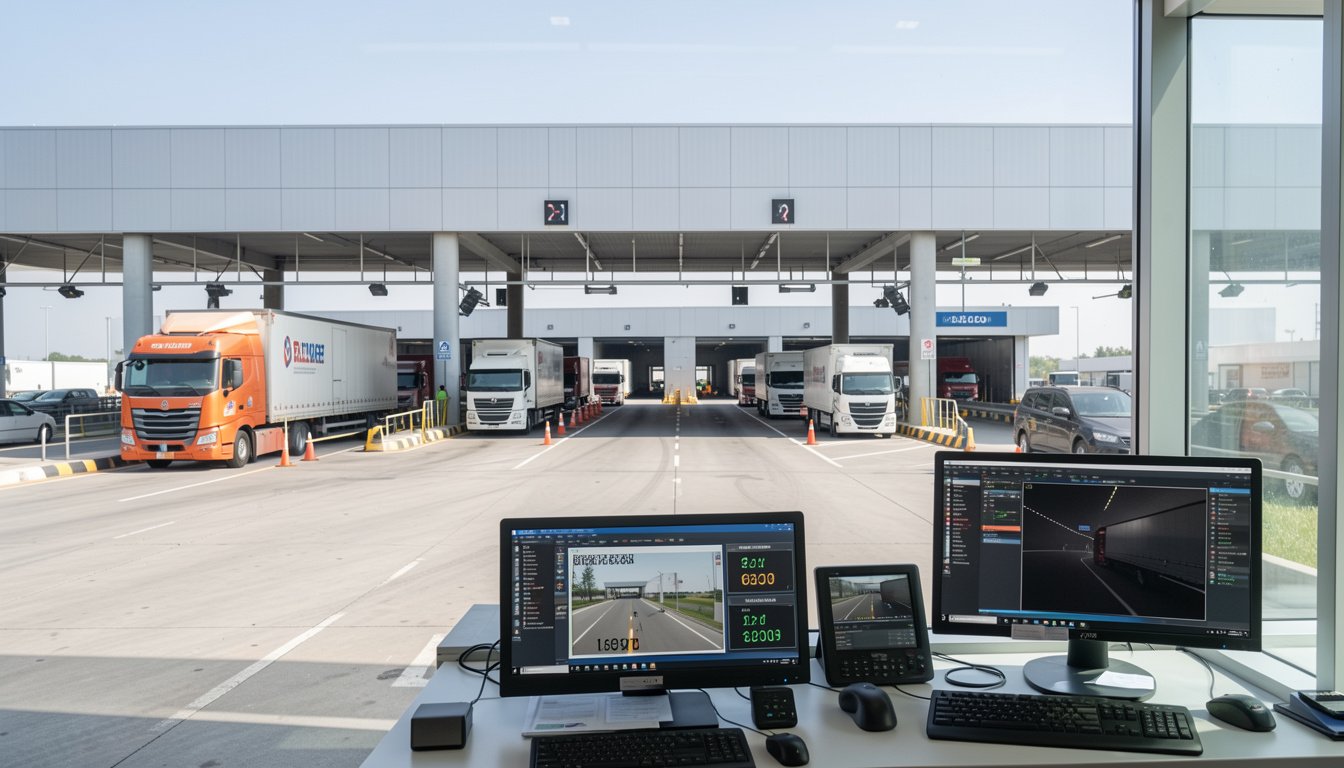
Logistics dashboard and surveillance interface on control room monitors tracking truck traffic at a large distribution hub entrance
B. Rental Car Returns
The Scenario: A customer returns a rental car. Usually, an agent walks around the car, checks the odometer, and scans the barcode.
The Fix: The customer drives through an ALPR+ "tunnel."
The Result: The system identifies the car by plate and model immediately. It timestamps the return, stopping the billing clock instantly. The customer gets a receipt on their phone before they even unbuckle their seatbelt.
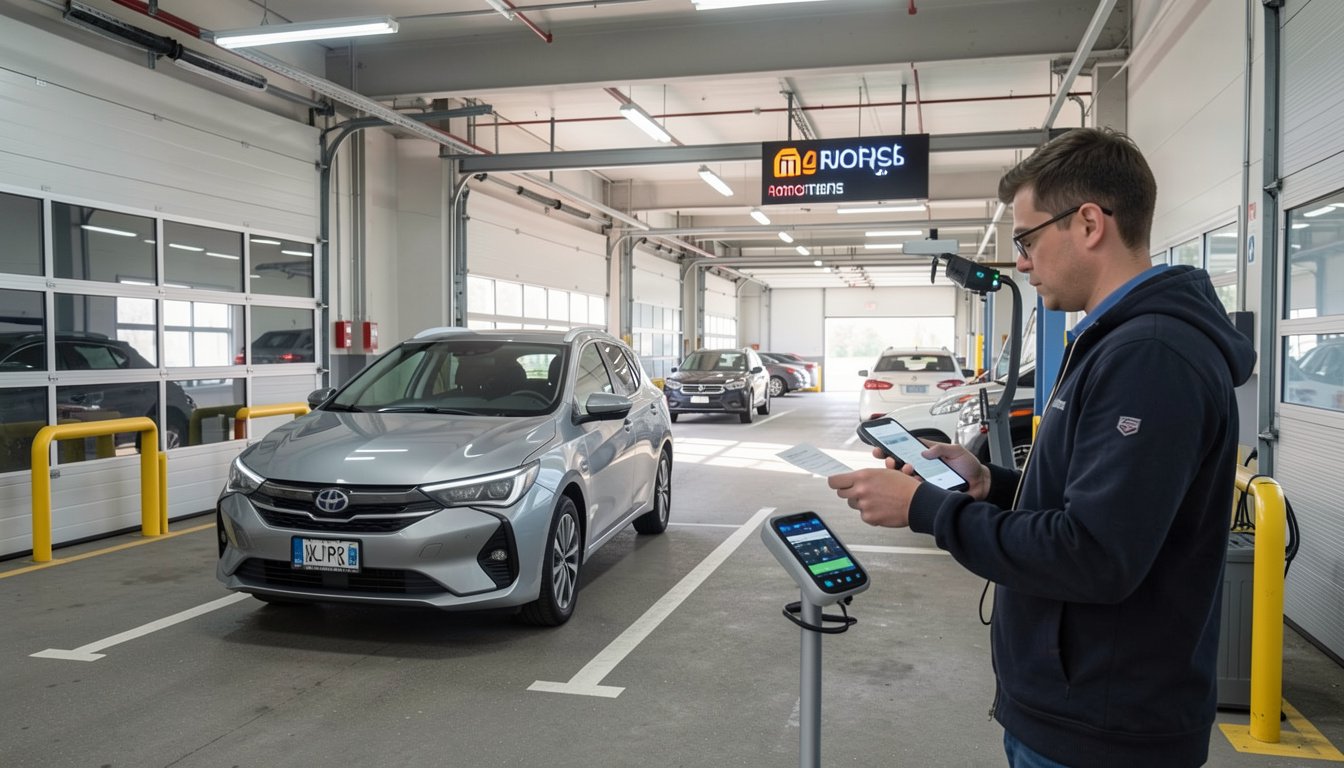
Car rental return agent processing a vehicle check-in using mobile technology in a covered service garage
C. Corporate Campuses & Gated Communities
The Scenario: Employee parking management.
The Fix: "Fuzzy Matching" access.
The Result: Sometimes a plate is covered in snow or mud. Standard ALPR fails. Sighthound ALPR+ sees a Blue Tesla Model 3 approaching. It checks the database: "Do we have a Blue Tesla registered to an employee?" If there is only one, and the partial plate match is close, the gate opens. Convenience meets security.
Best Practices for High Accuracy
To get the most out of your ALPR+ system, follow these deployment rules.
1. Maintain Your Database
Computers are only as good as the data they use. Ensure your fleet database is updated regularly. If you buy new trucks, their plates and their Make/Model must be entered into the system.
2. Clean Your Cameras
It sounds simple, but dirty lenses are the #1 cause of system failure. Logistics yards are dusty. A monthly schedule to wipe down camera lenses (and IR illuminators) is necessary.
3. Monitor "Confidence Scores"
Sighthound provides a "confidence score" with every read. Set up alerts for low confidence. If a specific camera consistently returns low confidence scores (e.g., below 70%), it likely means the camera has moved, focus has drifted, or a spider has built a web across the lens.
4. Privacy & Compliance
Tracking vehicles comes with responsibility.
Data Retention: Define how long you keep the data. For operational logs, 30-90 days is common.
GDPR/CCPA: Ensure your system follows local privacy laws regarding license plate data storage. Sighthound’s edge processing capabilities can help here by processing data locally and only storing text, not images, if required for privacy.
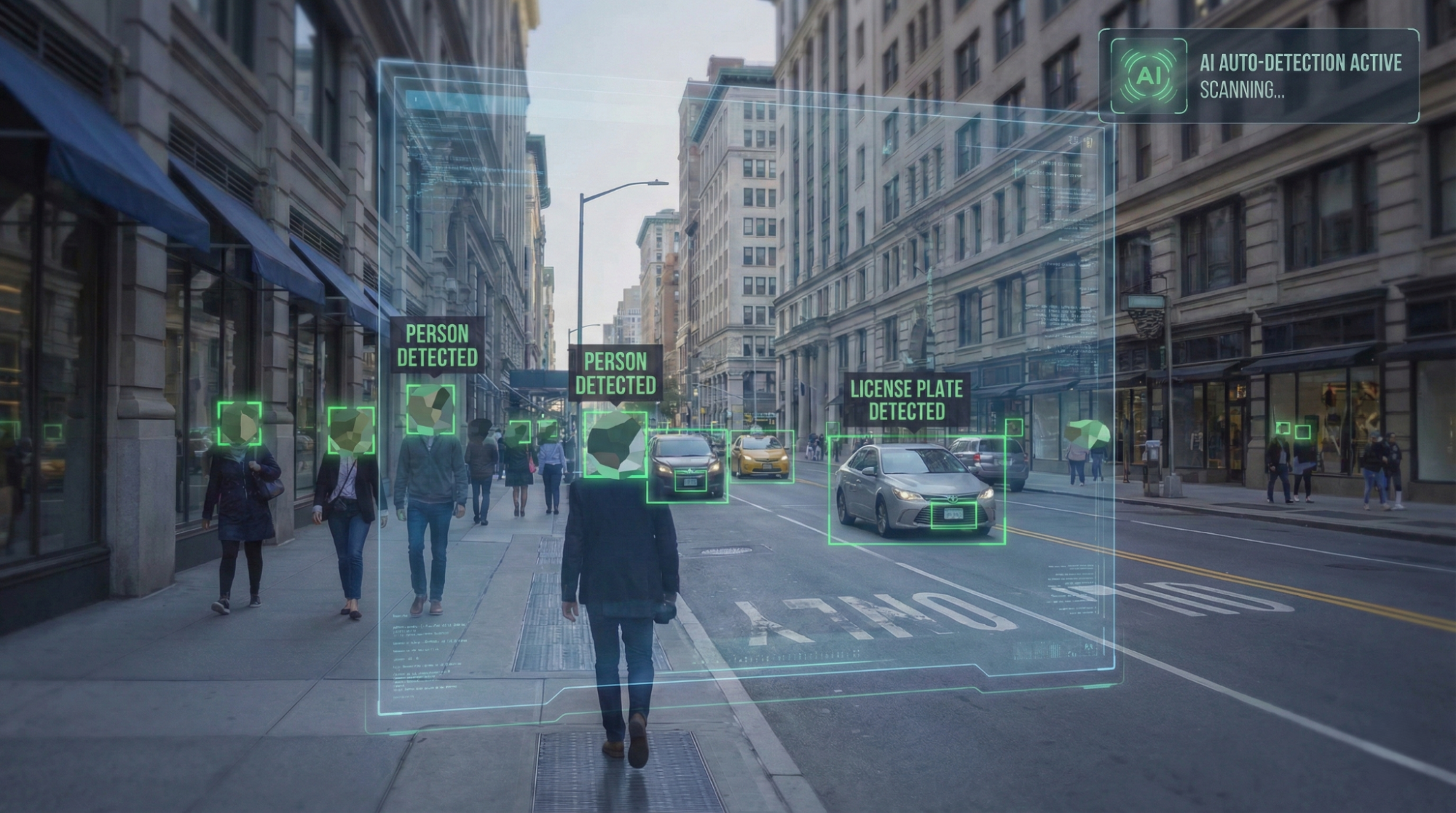
Computer vision software demonstration displaying 'Person Detected' and 'License Plate Detected' metrics on a busy urban street
What is Sighthound ALPR+? (More Than Just OCR)
Traditional Automatic License Plate Recognition (ALPR) systems have existed for decades. They use Optical Character Recognition (OCR) to find high-contrast text in an image and convert it to digital characters.
Sighthound ALPR+ is the updated version of this technology. It moves beyond simple OCR by using Computer Vision and Deep Learning.
The "See, Read, Verify" Pipeline
Sighthound ALPR+ does not just read text; it interprets the scene. Here is the workflow that happens in under 200 milliseconds:
ALPR+ Features
Make, Model, Colour, and Generation (MMCG) Recognition: Accurately identifies detailed vehicle attributes for better filtering, search, and analytics.
License Plate Detection Across 100+ Countries: Built-in localisation makes it ideal for global deployments and international operations.
Real-Time Vehicle & Object Tracking: Continuously monitors vehicle movement, enabling proactive security and traffic flow management.
Edge Deployment with GPU Acceleration: Enables fast, offline operation with reduced latency and minimal bandwidth usage.
Flexible API Integrations: Easily connect with existing VMS, access control, tolling, or smart city platforms.
Privacy Compliance and Redaction Options: Supports privacy-focused operations with built-in redaction and encryption protocols.
The Future of Fleet Entry
The era of the clipboard is over. Relying on manual entry logs is a risk you can no longer afford.
The technology is ready. The cameras are standard. The API is open. The only question remaining is: How much is that manual log really costing you?
Want to see AI-powered LPR in action? Explore Test Drive ALPR+ Now For Free.
For business opportunities, explore our Partner Program today.