
License Plate Analytics for Ambulance Access and Emergency Response
The high-stakes world of emergency medical services (EMS), the difference between a positive clinical outcome and a tragedy often boils down to seconds. We speak frequently of the "Golden Hour" that critical window where medical intervention has its highest impact. However, while medical technology inside the ambulance has advanced at a breakneck pace, the physical infrastructure of our cities and hospitals often remains a legacy of friction.
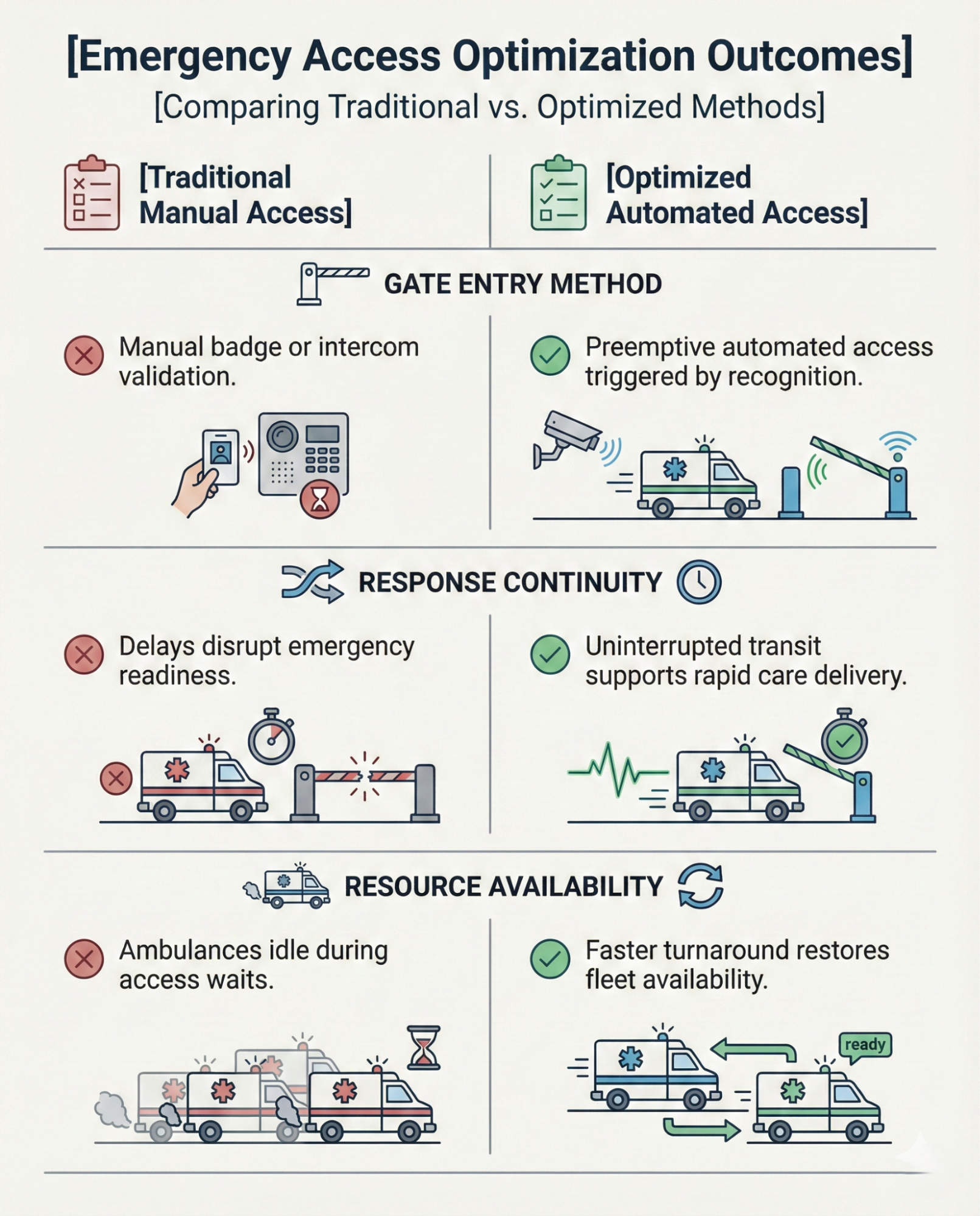
Consider the journey of an ambulance: it navigates through gridlocked traffic, maneuvers around double-parked delivery vans, and finally reaches the hospital only to be met by a security gate that requires a physical badge swipe or a manual intercom call. This "last-mile" bottleneck is more than an inconvenience; it is a systemic failure in the chain of survival.
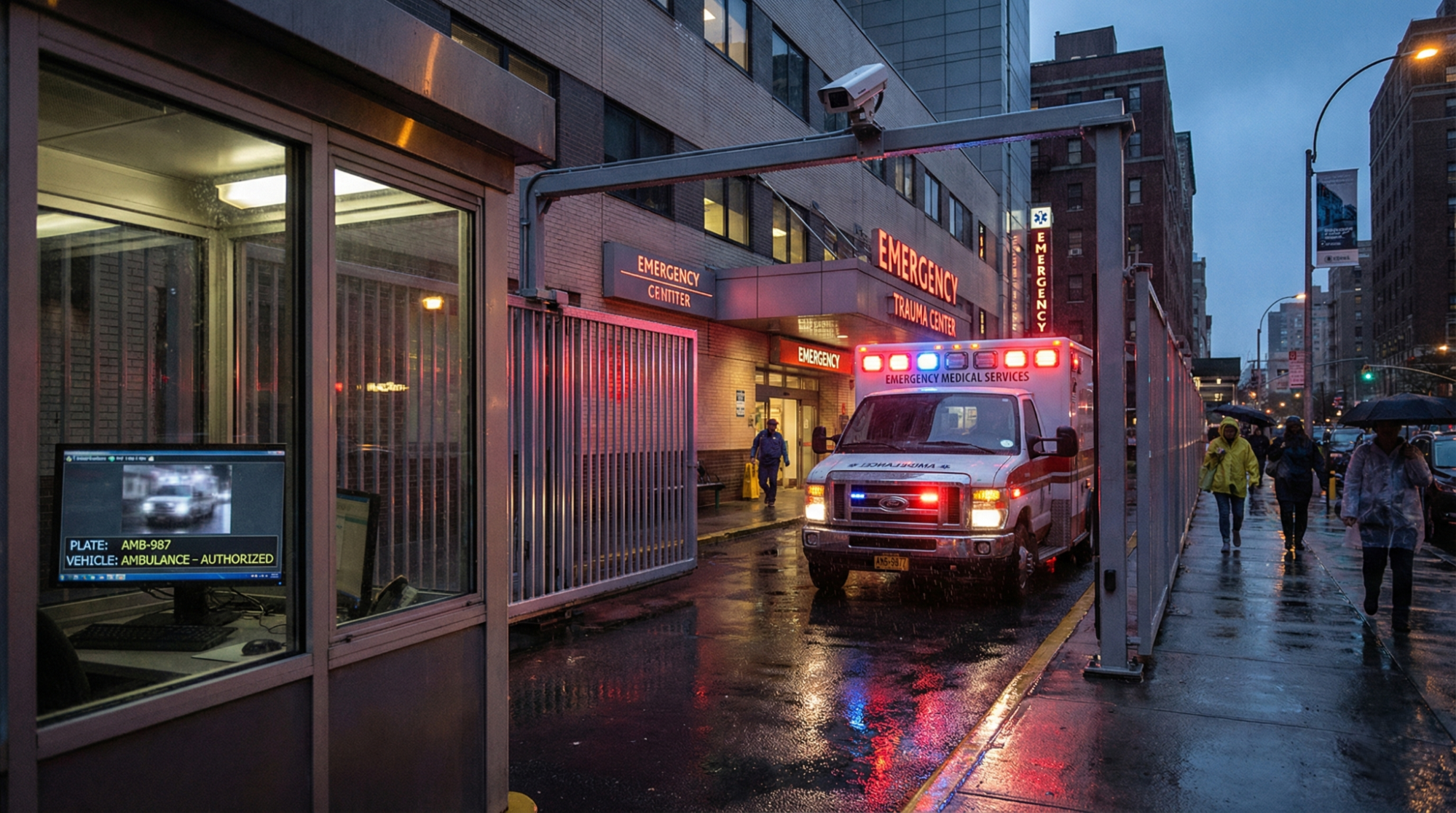
An ambulance with flashing lights arrives at a city hospital’s emergency trauma center entrance on a rainy evening, seen through an automated security gate.
By leveraging advanced computer vision and deep learning, Sighthound is transforming static security cameras into proactive Vehicle Intelligence nodes. This technology does not merely "read" a plate; it understands the vehicle's "fingerprint," ensuring that when a life is on the line, the path is cleared before the wheels even reach the gate.
The Evolution of ALPR: From Text Recognition to Vehicle Intelligence
To understand why Sighthound ALPR+ is a interchanger for emergency response, one must first understand the limitations of traditional ALPR systems. Legacy systems rely on Optical Character Recognition (OCR), which attempts to convert the shapes on a license plate into alphanumeric text.
While OCR was revolutionary twenty years ago, it is notoriously fragile in real-world conditions. A plate obscured by snow, mud, or the glare of high-beam headlights can render a traditional system useless. For an ambulance arriving in a storm, a failure rate of even 5% is unacceptable.
Learn more about the mechanics of number plate recognition to see how these systems have evolved.
The "Plus" Factor: MMCG Analytics
Sighthound ALPR+ solves this by moving beyond the plate. Our system utilizes a multi-layered AI pipeline that analyzes the Make, Model, Color, and Generation (MMCG) of the vehicle.
For a deeper look at this tech, check out our guide on smart vehicle recognition.
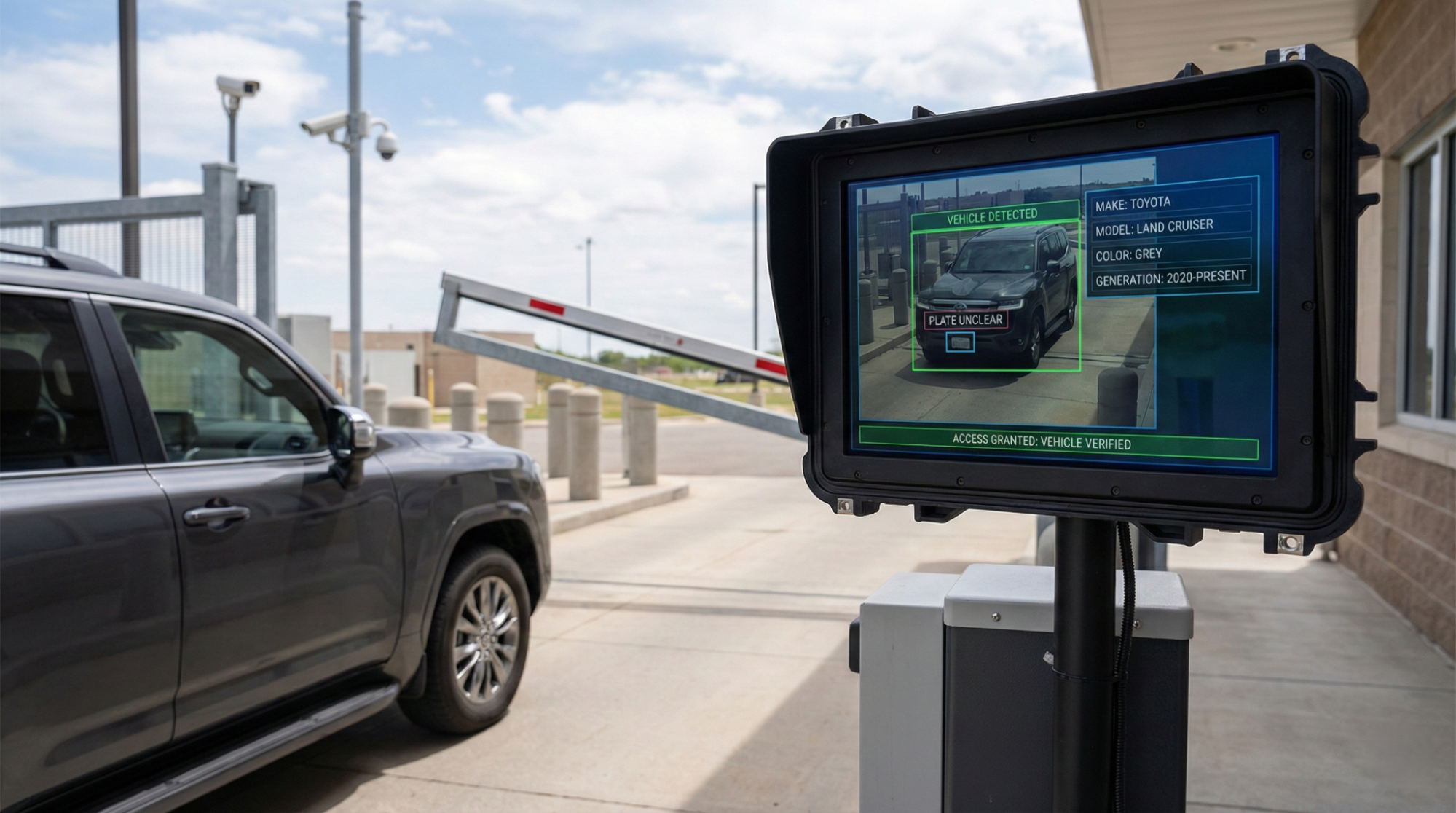
A grey Toyota Land Cruiser at a security gate being scanned by an automated vehicle recognition system that displays vehicle make, model, and "Access Granted" on a digital monitor.
The Technical Pipeline:
Detection & Localization: The AI scans the video feed to identify a "vehicle" object, separating it from the background noise of pedestrians or stray animals.
Character Recognition (OCR): The system extracts the plate text and identifies the issuing jurisdiction (e.g., California, Florida,).
Verification & Trigger: If the plate is unreadable, the system can use the MMCG data (e.g., "White Ambulance") as a secondary verification to trigger a gate opening.
"In critical infrastructure, reliability is the only metric that matters. ALPR+ provides a redundant layer of intelligence that assures gates open based on what the vehicle is, not just what its plate says."
Reducing Offload Times: The Smart Hospital Bay
One of the most significant metrics in hospital management is "Ambulance Offload Delay" (AOD). This occurs when an ambulance is forced to wait in a parking lot because the emergency bay is full or inaccessible. AOD doesn't just keep patients waiting; it keeps ambulances out of service, preventing them from responding to the next 911 call.
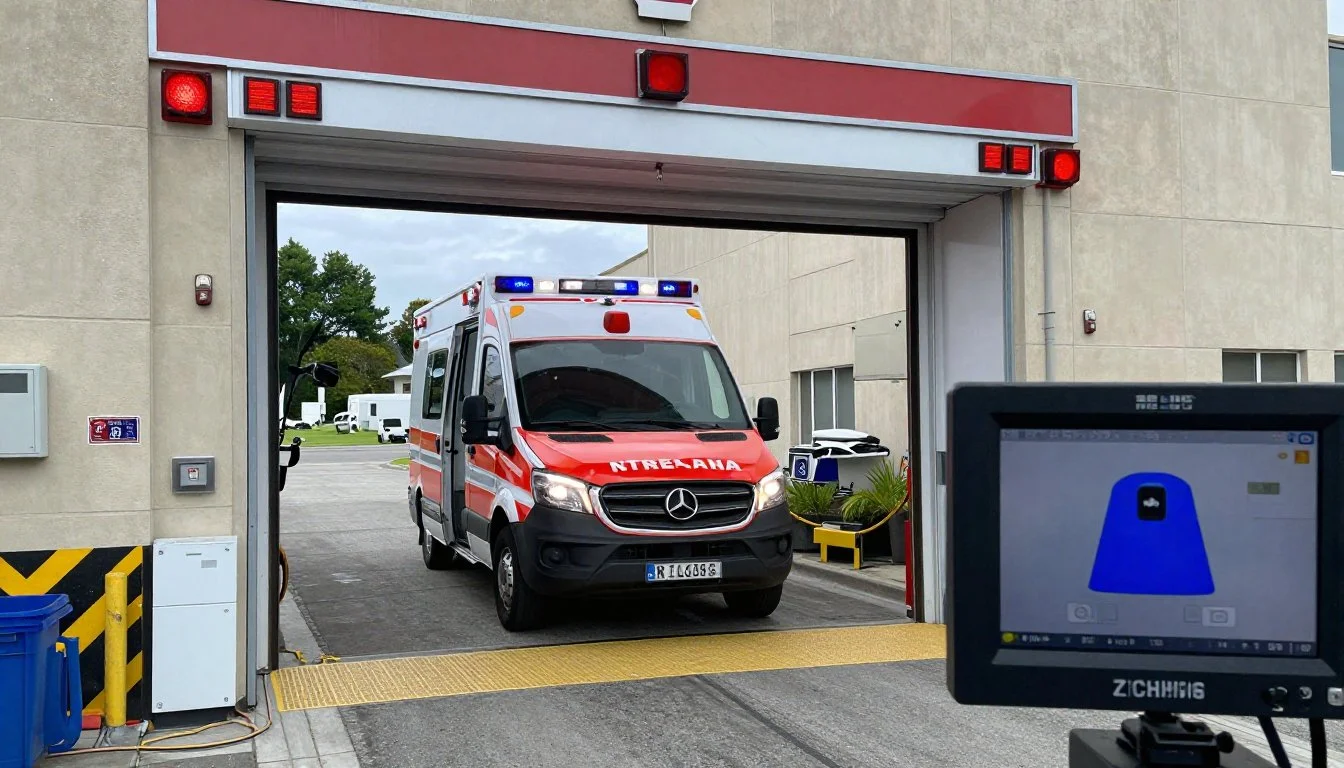
Security monitor verifying a grey Toyota Land Cruiser for access at an automated gate
Automated Perimeter Clearance
By integrating Sighthound ALPR+ with a license plate recognition access control system, administrators can create a "frictionless corridor":
Advance Identification: Fixed cameras at the hospital’s outer perimeter identify an authorized EMS vehicle 50 to 100 feet from the gate.
Instantaneous Logic: The system cross-references the vehicle with the "white-list" and confirms it is an active emergency unit.
Pre-emptive Action: The gate begins to lift while the ambulance is still in motion, allowing the driver to maintain speed and focus on the patient rather than reaching for a badge.
Managing Illegal Parking in Emergency Zones
Civilian vehicles often block emergency access points. ALPR+ acts as an automated "digital sentry," identifying unauthorized vehicles and allowing for effective parking management through automated alerts or enforcement.
Detection of Unauthorized Vehicles: If a vehicle without an "Emergency" or "Authorized" tag enters a restricted bay, the system triggers an immediate alert to security.
Automated Enforcement: The system logs the plate, MMCG, and timestamp, allowing for automated ticketing or towing notifications to keep the lane clear for incoming ambulances.
Field Operations: ALPR+ in the Patrol Car
Emergency response isn't limited to hospitals. Law enforcement teams and first responders in the field use mobile ALPR+ to manage public safety in real-time.
The Mobile Advantage
Sighthound ALPR+ is designed for Edge-First processing. This means the heavy lifting of the AI is done on a ruggedized Compute Node inside the patrol car, rather than relying on a shaky cellular connection to the cloud. Discover the benefits of Edge AI for real-time response.
Key Field Applications:
The "Hotlist" Search: Officers can be notified instantly if a vehicle on a "Stolen" or "Wanted" list passes their camera.
AMBER Alerts: When a child goes missing, time is of the essence. Instead of just searching for a plate number (which a suspect can easily change), officers can set an alert for a "Blue 2018-2022 Honda Odyssey." The MMCG analytics will flag every matching vehicle, regardless of the plate.
Incident Reconstruction: After a disaster or mass casualty event, ALPR+ logs provide a searchable database of every vehicle that entered or exited the scene, providing invaluable data for investigators.
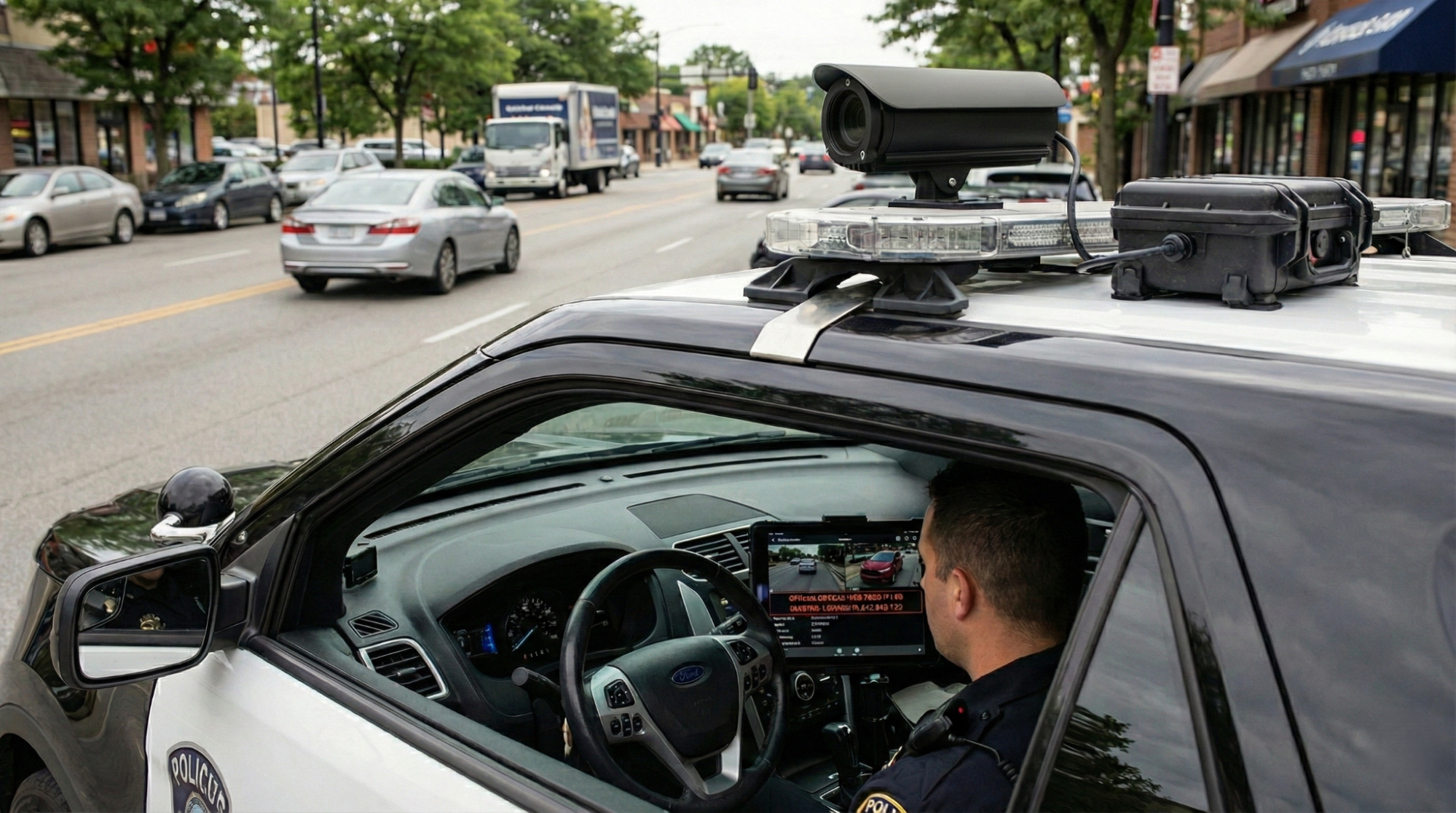
Police officer using an automated license plate reader system from inside a patrol vehicle
Overcoming Environmental Challenges
Emergency response happens 24/7, 365 days a year. A system that only works in perfect daylight is a liability. ALPR+ is engineered to withstand the most punishing conditions.
Low Light and High Speed
Our AI models are trained on millions of images encompassing various lighting conditions. Whether it is a midnight response on a rural highway or an ambulance arriving at high speed, the system maintains high accuracy levels.
Angle and Perspective Correction
In many hospital layouts, cameras cannot be mounted directly in front of the vehicle. They are often placed at sharp angles on corners or high up on light poles. Sighthound’s spatial reasoning allows the AI to "de-warp" the plate and vehicle profile, ensuring a correct read even from extreme perspectives.
Privacy, Compliance, and Data Security
In a healthcare setting, the privacy of patients and bystanders is paramount. Every video frame captured is viable PII (Personally Identifiable Information).
Integrated Redaction
Sighthound ALPR+ is designed to work in tandem with Sighthound Redactor, which can improve patient care by ensuring data security:
Automatically Blur Faces: assures that patients on stretchers or bystanders are not identifiable in video logs.
Anonymize Background Plates: If an ambulance is tracked, the system can automatically redact the license plates of all other civilian vehicles in the frame to maintain privacy.
Encrypted Data Streams: All vehicle data is encrypted at the source (the Edge) and transmitted via secure APIs to the hospital's database, ensuring compliance with CCPA, GDPR, & HIPAA.
The Economic Impact of Vehicle Intelligence
While the primary goal of ALPR+ in emergency response is saving lives, the operational ROI for health systems and municipalities is substantial.
Security gate monitor verifying a Toyota Land Cruiser for automated access
By automating the mundane task of access control, hospitals can reallocate their high-cost human resources (like nurses or security officers) to direct patient care and active threat mitigation.
Future Horizons: ALPR+, Drones, and the Smart City
As we look toward the future of 2026 and beyond, vehicle intelligence will not exist in a vacuum. It will be the "ground layer" of a unified emergency ecosystem.
The Ground-to-Air Handshake
We are already seeing the rise of Medical Drones for the transport of organs and vaccines. Sighthound ALPR+ can serve as the ground coordinator for these missions. When a drone carrying a donor kidney arrives at a hospital landing pad, the ALPR+ system can identify the specialized courier vehicle waiting on the ground, ensuring the "hand-off" happens in a secure, pre-cleared zone.
Predictive Traffic Pre-emption
Imagine a city where traffic lights don't just turn green for sirens, but for validated emergency vehicles. By integrating ALPR+ with municipal traffic management systems (UTM), cities can create "Dynamic Emergency Corridors." As an ambulance approaches an intersection, the ALPR+ camera confirms its identity and triggers a green light, clearing traffic blocks before the ambulance even reaches the queue.
The Path Forward
The integration of License Plate Analytics into emergency response protocols represents a shift from reactive security to proactive intelligence.
Sighthound ALPR+ provides the reliability, speed, and depth of data required to make this vision a reality. By recognizing not just a plate, but a vehicle’s entire identity, we are helping first responders do what they do best: save lives.
ALPR+ Features
Make, Model, Colour, and Generation (MMCG) Recognition: Accurately identifies detailed vehicle attributes for better filtering, search, and analytics.
License Plate Detection Across 100+ Countries: Built-in localisation makes it ideal for global deployments and international operations.
Real-Time Vehicle & Object Tracking: Continuously monitors vehicle movement, enabling proactive security and traffic flow management.
Edge Deployment with GPU Acceleration: Enables fast, offline operation with reduced latency and minimal bandwidth usage.
Flexible API Integrations: Easily connect with existing VMS, access control, tolling, or smart city platforms.
Privacy Compliance and Redaction Options: Supports privacy-focused operations with built-in redaction and encryption protocols.
Ready to Modernize Your Facility?
Don't let legacy hardware slow down your response times. Discover how Sighthound ALPR+ can transform your hospital’s perimeter security and emergency logistics.
Want to see AI-powered LPR in action? Explore Test Drive ALPR+ Now For Free.
For business opportunities, explore our Partner Program today.
Frequently Asked Questions (FAQ)
-
Traditional ALPR uses OCR to read license plate text. ALPR+ adds Vehicle Intelligence, analyzing the Make, Model, Color, and Generation (MMCG) of a vehicle. This allows for identification even if the license plate is obscured or missing.
-
ALPR+ enables Automated Gate Pre-emption, identifying authorized ambulances 50–100 feet away and opening gates before they arrive. It also acts as a "digital sentry" to keep emergency bays clear of unauthorized parked vehicles.
-
No. The system is designed for anonymous vehicle identification. It focuses on the rear of vehicles and does not record driver or passenger faces. Integrated tools like Sighthound Redactor can also automatically blur bystanders for HIPAA compliance.
-
Yes. ALPR+ uses AI-driven preprocessing and Infrared (IR) illumination to maintain high accuracy in rain, snow, and total darkness. It is trained to handle high-speed motion and extreme camera angles.
-
Sighthound uses Edge-First architecture, meaning data is processed locally on a Compute Node at the gate or in the vehicle. This assures near-zero latency and removes reliance on a potentially unstable cloud connection.
-
Yes. The customer owns 100% of the data. Data is typically stored on an FBI-compliant server for 30 days before being deleted, unless it is needed for an active investigation.
