
How parking operators actually use license plate recognition
Parking management is operationally messy. Attendants patrol lots manually, payment disputes become he-said-she-said, permit violations go undetected for hours, and data lives in disconnected silos. For decades, this was the industry standard.
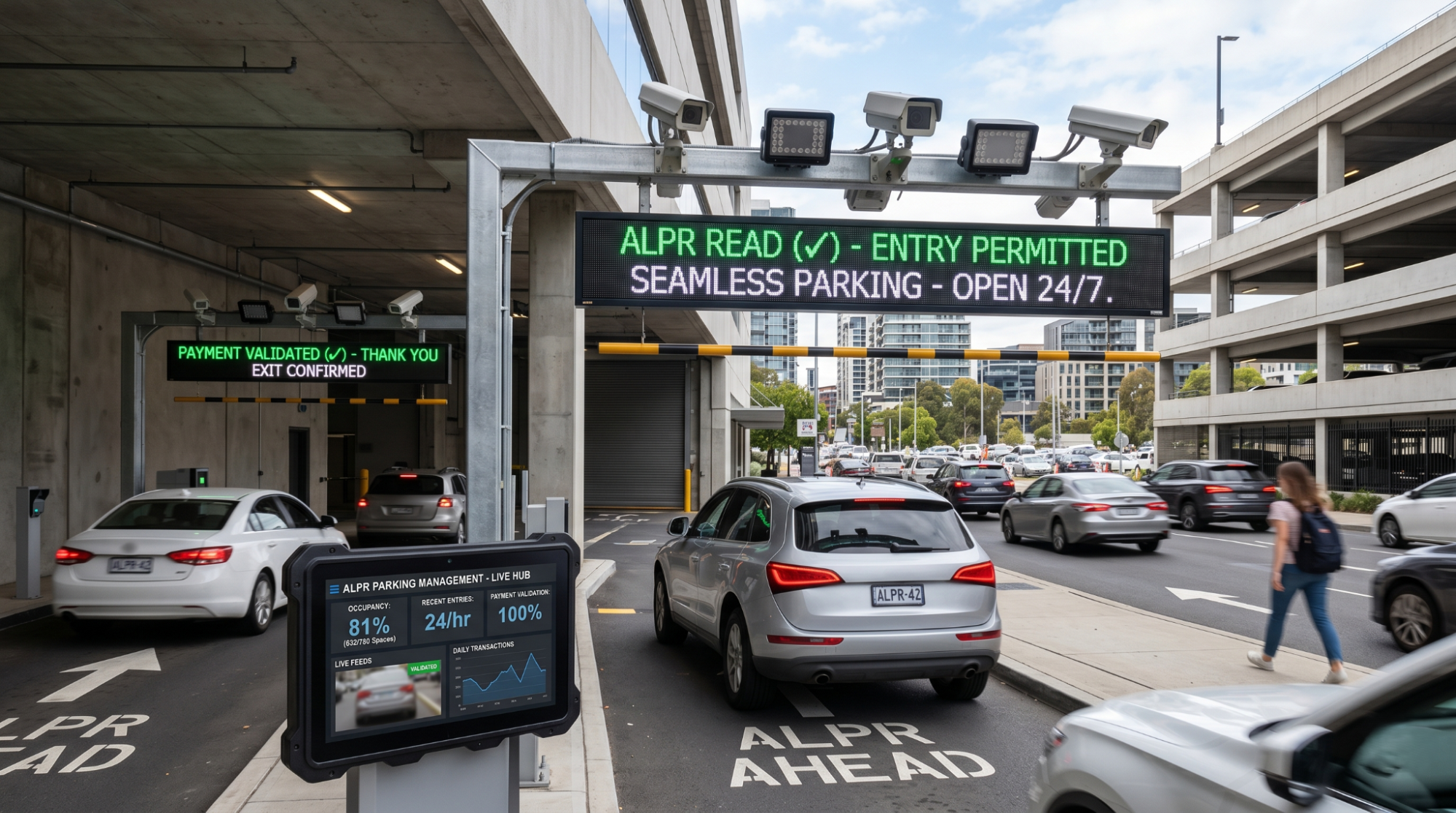
Cars entering and exiting a smart parking garage equipped with an Automatic License Plate Recognition (ALPR) system, featuring overhead digital validation signs and a live parking management dashboard.
License plate recognition (ALPR) systems are changing that. But parking operators aren't deploying them just to catch violators, they're using them as the operational backbone of modern parking management. ALPR enables ticketless entry, automatic permit enforcement, real-time payment validation, and data-driven decision-making.
Here's how parking professionals are actually using license plate recognition today.
What License Plate Recognition Does for Parking
License plate recognition (also called ALPR or automatic license plate recognition) is straightforward, a camera reads vehicle plates, extracts the data, and matches it against a database in real time. For parking operators, this creates a complete audit trail of every vehicle entry, exit, payment, and violation.
Traditional parking workflows rely on tickets, kiosks, and manual enforcement. ALPR replaces this with automated identification.
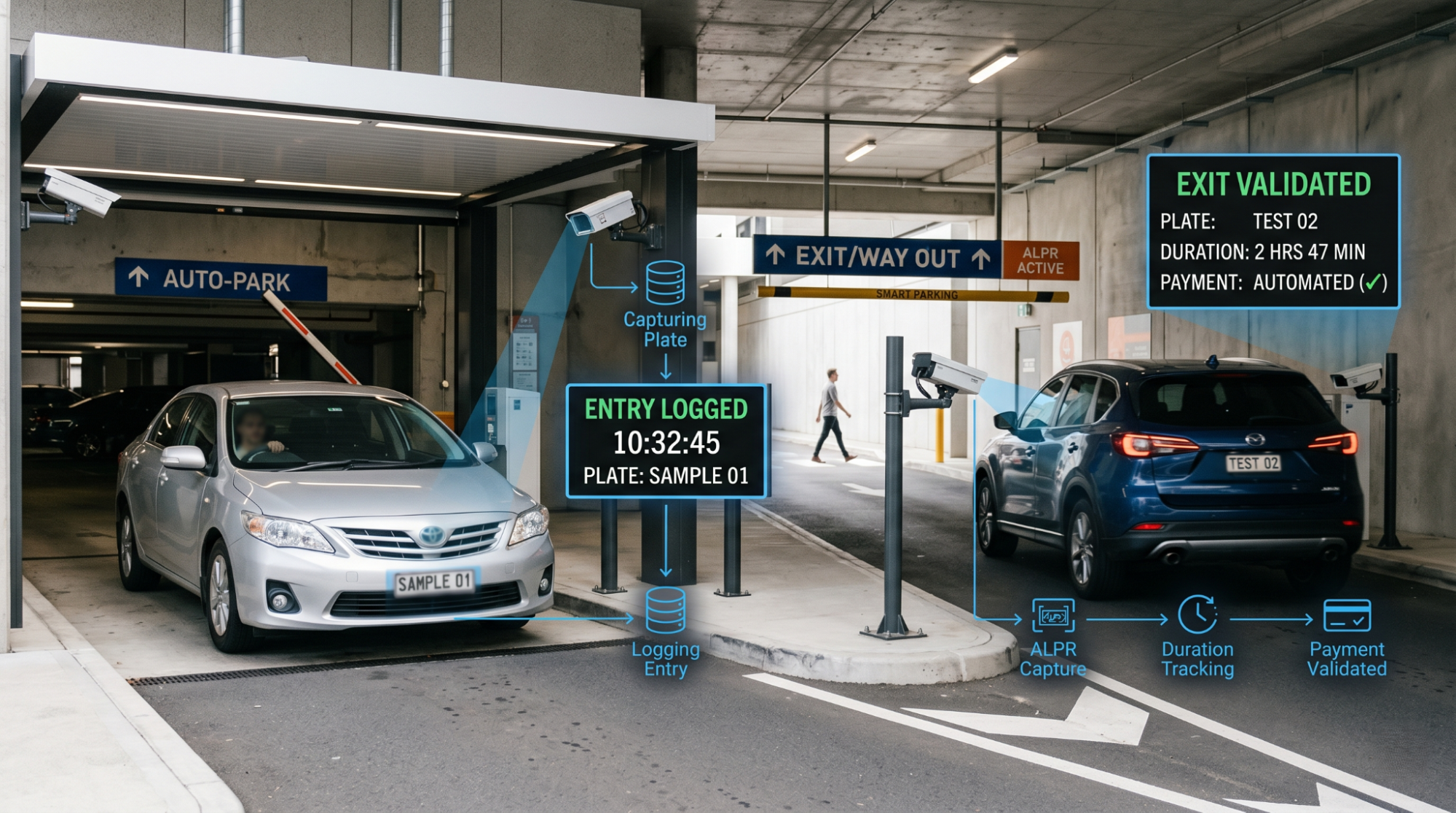
An illustration showing how an ALPR smart parking system works, featuring cameras that capture license plates for automated entry logging and exit payment validation.
When a vehicle enters a facility, an ALPR camera captures the plate and logs entry time. When it exits, another camera captures the plate again. The system knows exactly how long the vehicle occupied the space, calculates the fee automatically, and can verify payment without physical proof. No lost tickets, no payment disputes, no ambiguity about who parked where.
This real-time data flow transforms parking from a manual, reactive operation into an automated, data-driven one.
Why Parking Operators Need Automated Systems Today
Modern parking facilities face five core operational challenges:
Manual enforcement costs money.Parking attendants must patrol constantly to catch violations, overstays, and unauthorized parkers. This is labor-intensive, reactive, and often ineffective, violations go undetected for hours.
Payment disputes are common. Without objective identification, disagreements about who parked, for how long, and whether they paid become impossible to resolve. No clear proof exists.
Permit compliance is hard at scale. Managing resident permits, visitor passes, disabled parking, and staff designations across a large lot requires constant staff attention or legacy software that doesn't scale.
Security visibility is limited. Unauthorized vehicles, stolen cars, and watchlist matches are often discovered after the fact, if at all.
Data silos prevent optimization. Payment systems, permit databases, and enforcement logs don't communicate, so operators can't see patterns or optimize operations.
Automated license plate recognition solves each of these problems directly.
How Parking Operators Use ALPR: Real-World Applications
Ticketless Parking with Automated Entry/Exit
Imagine a customer driving into a parking garage with no ticket machine, no payment kiosk, no attendant at the gate.
An ALPR camera at the entrance reads their license plate instantly, grants access, and logs entry time. When they leave, another camera reads the plate. The system calculates parking duration, applies the correct rate, deducts payment from their registered method, and raises the gate. Total interaction, zero.
This is ticketless parking, now deployed at hundreds of facilities globally. Operators report:
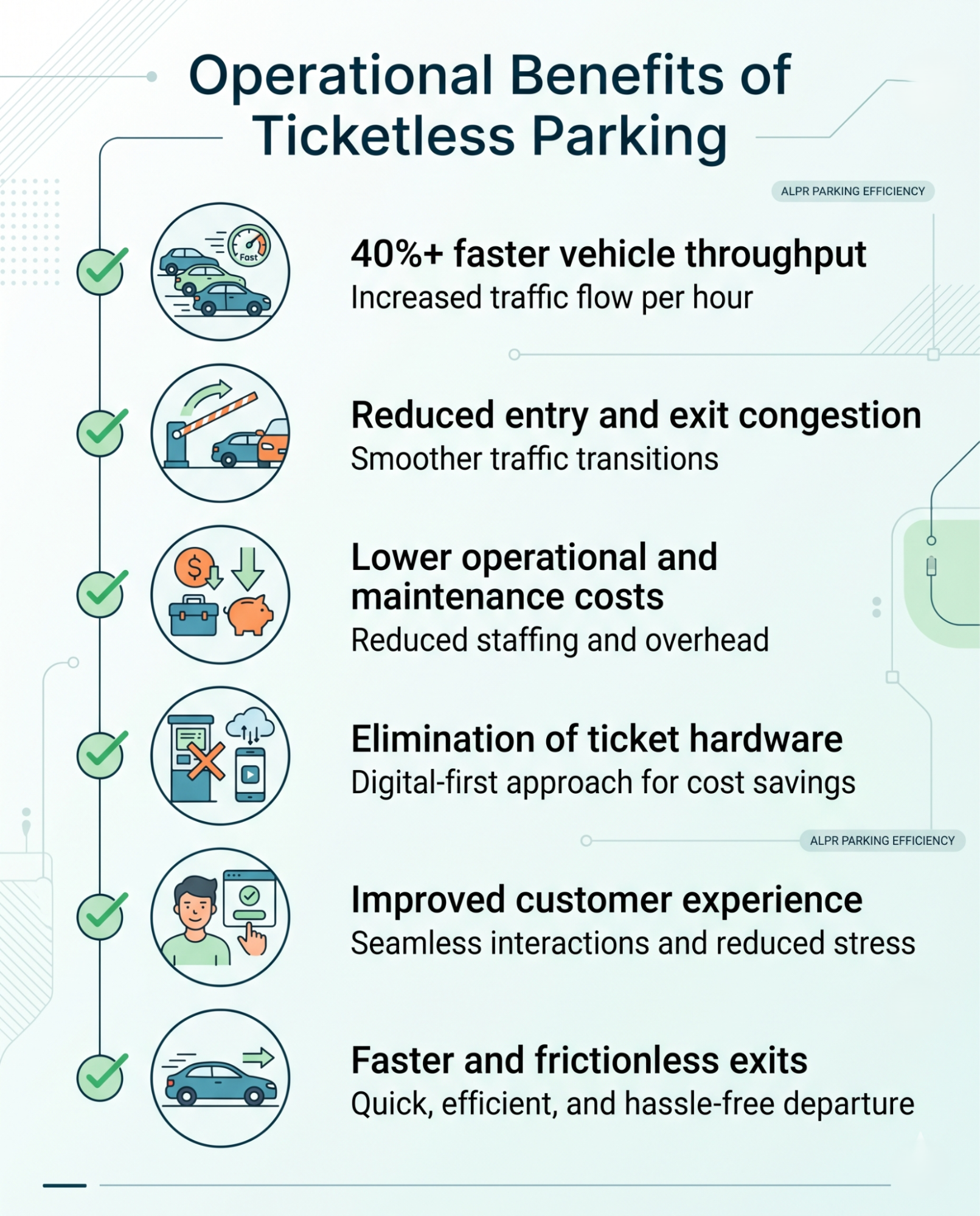
A visual list of ticketless parking advantages, highlighting how ALPR efficiency reduces congestion, eliminates physical ticket hardware, and lowers maintenance costs while speeding up vehicle throughput.
Automated Permit Enforcement and Validation
Campus parking and residential communities depend on permit systems. Students with valid permits park freely, visitors occupy designated zones for limited hours. Enforcing this manually means staff physically checking every windshield.
ALPR automates permit enforcement. The system maintains a database of valid permits linked to license plates. When a vehicle enters, the ALPR camera reads the plate and checks it against the permit database instantly. Unauthorized vehicles in restricted zones trigger immediate alerts.
Results:
Violations caught immediately, not hours later
Reduced disputes (data shows exactly which permits the vehicle holds)
Flexible enforcement (staff prioritize high-value violations)
Auditable compliance records for regulatory requirements
Overstay Detection and Automated Enforcement
One of the most common parking violations is overstaying. A customer pays for two hours but parks for three. Detecting this manually requires staff to periodically check vehicles.
ALPR detects overstays automatically. The moment a vehicle exceeds paid time, the system identifies the violation and can generate a notice without human intervention. The same applies to reserved zones (handicapped parking, loading areas) and no-entry areas.
This eliminates guesswork and reduces staff workload significantly.
Payment Validation and Dispute Resolution
Payment disputes plague parking operations. A driver claims they paid, but the operator has no record. Who's right?
ALPR connects vehicle identification directly to payment records. The plate captured at entry matches the payment in the system. If no valid payment is found, the system flags the vehicle for collection or enforcement. Disputes are resolved with objective data, not arguments.
Vehicle Attribute Recognition
License plates are the primary identifier, but they're not foolproof. Plates can be obscured by dirt, damaged, or occasionally misread by cameras. In crowded lots, relying only on plate reads can lead to disputes.
This is where vehicle attribute recognition enhances automated parking systems. By analyzing the vehicle's physical characteristics, color, body style, and size, the system adds a verification layer.
Example: A system detects an overstaying violation, but the plate read is partially obscured. Instead of relying solely on uncertain data, it confirms the violation by matching the vehicle's color and model against entry footage. Enforcement staff have confidence that they're issuing violations to the correct vehicle.
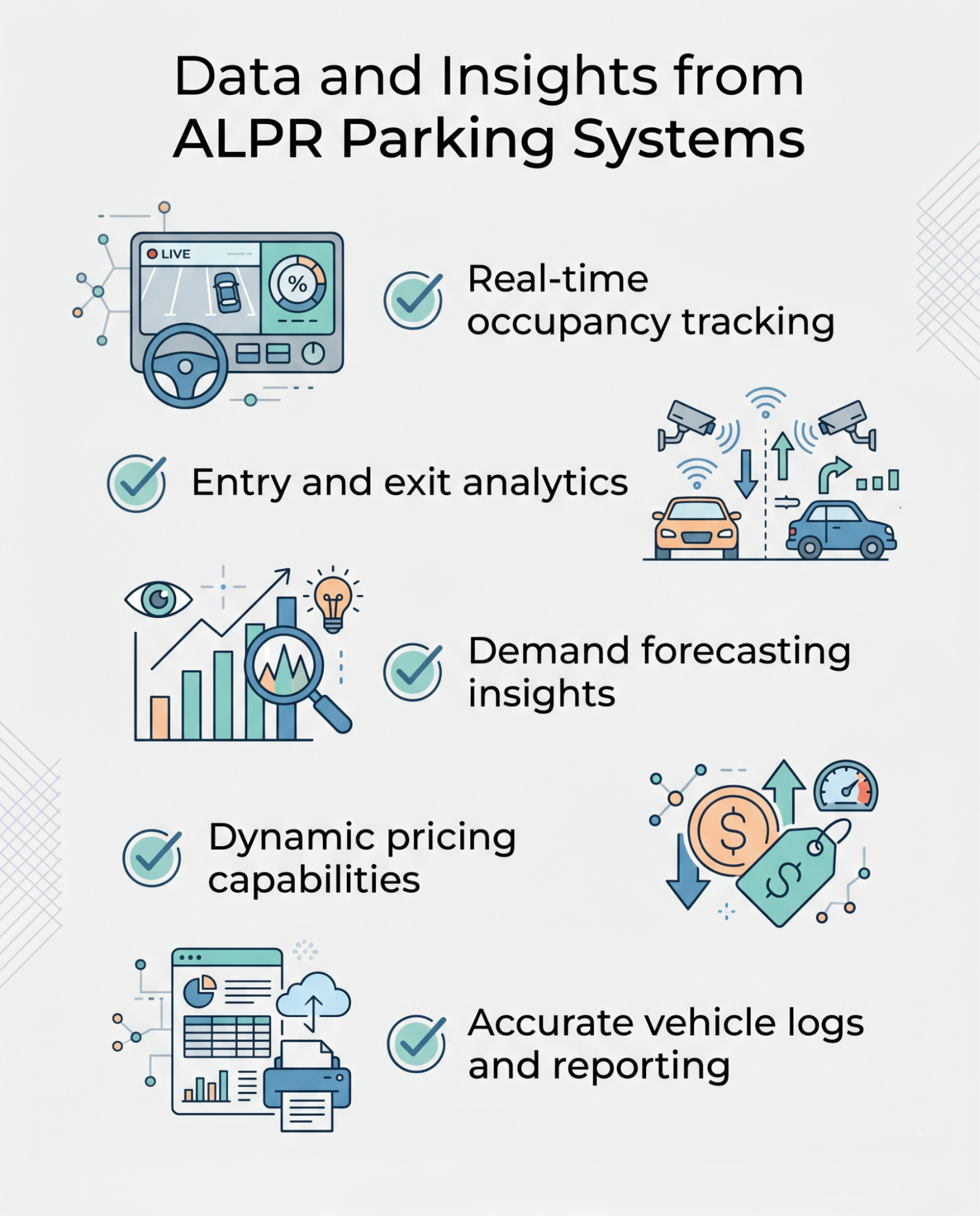
Visual list of data insights provided by smart parking systems, highlighting how ALPR technology enables dynamic pricing, real-time tracking, and comprehensive entry and exit analytics
Vehicle attributes also enable better search and filtering. If a lot manager receives a complaint about a specific vehicle ("blue sedan with tinted windows"), they can search by description even if the plate wasn't fully captured. For security teams investigating suspicious activity, vehicle characteristics become as important as plate numbers.
How ALPR Data Drives Better Operations
Beyond enforcement, license plate recognition systems generate data that transforms parking operations:
Occupancy insights: Real-time visibility into lot capacity helps managers optimize dynamic pricing, staffing, and customer messaging.
Demand forecasting: Historical data reveals peak hours, seasonal patterns, and event impacts. This informs pricing strategies and capacity planning.
Revenue optimization: Data on payment patterns, peak times, and customer segments enables smarter pricing and targeted promotions.
Security intelligence: Repeat violators, vehicles on watchlists, and stolen vehicles are flagged automatically.
Customer segmentation: Recognizing vehicle types (commercial, high-frequency parkers) enables targeted engagement.
Compliance auditing: Automated logs of all violations, payments, and permit checks create auditable records for regulators.
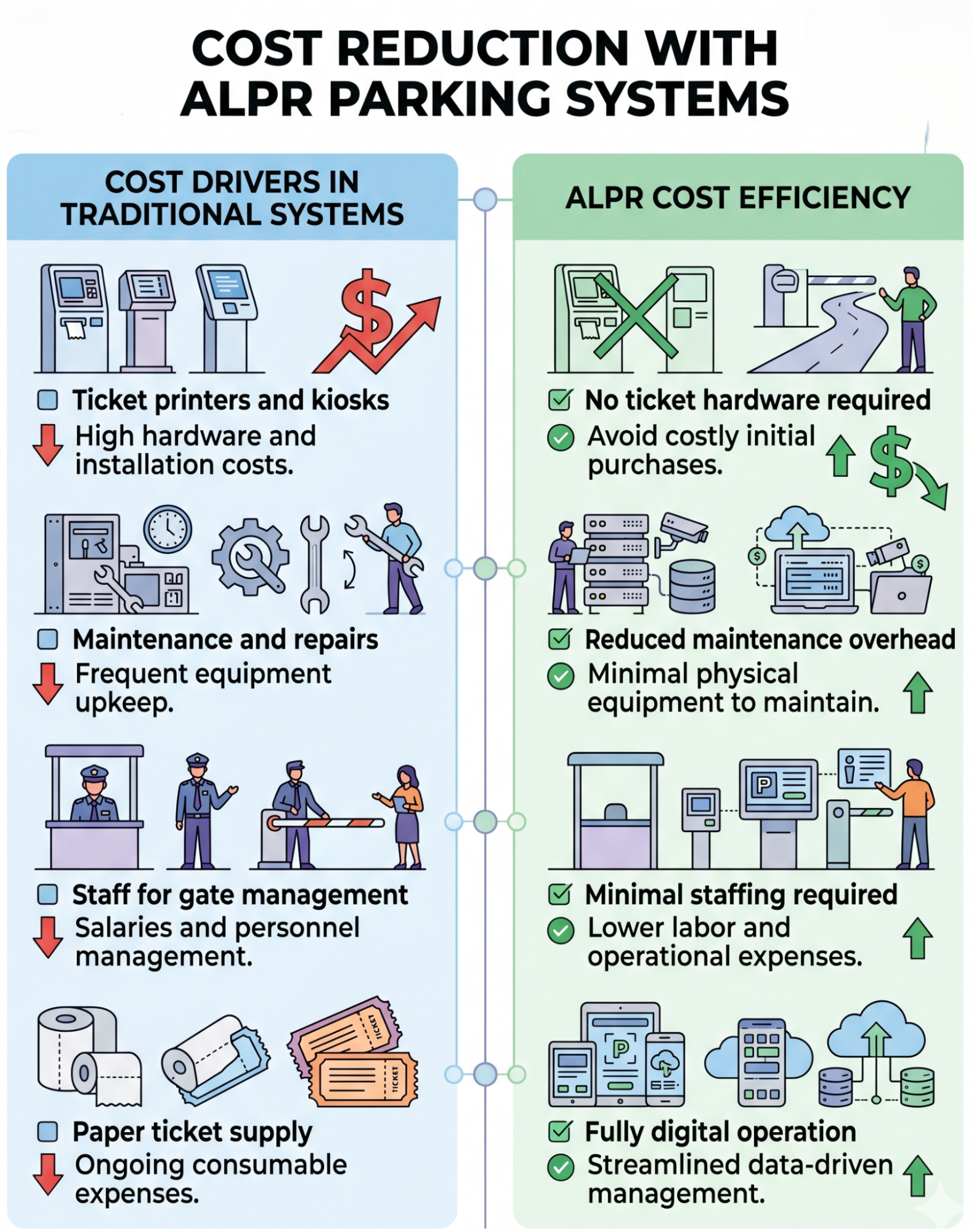
Visual infographic highlighting parking cost optimization. It contrasts the high overhead of traditional parking infrastructure with the streamlined, digital-first efficiency of Automatic License Plate Recognition (ALPR) technology.
Parking operators who leverage ALPR data shift from reactive enforcement ("Who's parking illegally today?") to proactive optimization ("How do we maximize revenue and customer satisfaction?").
Successful Implementation Considerations
Deploying license plate recognition requires thoughtful planning:
Integration: Modern ALPR systems must connect with existing gate hardware, payment processors, and permit databases. Assess compatibility with your current stack before deployment.
Privacy and governance: Clear policies on camera placement, data retention, and access controls protect customer privacy and ensure compliance with local regulations.
Staff training: Enforcement teams need to understand new workflows and how to interpret ALPR data. Change management is critical.
ROI calculation: Benefits include labor savings, recovery of violations, throughput improvements, and revenue optimization. A phased rollout often makes sense before full-facility deployment.
The Future of Parking Operations Is Automated
SighthoundALPR+ represents a huge leap in license plate recognition technology. More than just a plate reader, ALPR+ is a fully integrated, AI-powered vehicle intelligence platform. It is built to deliver exceptional accuracy, real-time insights, and actionable data, right at the edge.
The parking operators who embrace automated license plate recognition today will operate more efficiently, maintain better customer relationships, and build more profitable, scalable operations.
What sets ALPR+ apart is its ability to go beyond characters on a plate. By combining cutting-edge computer vision with deep learning models, ALPR+ provides a comprehensive understanding of each vehicle it encounters.
ALPR+ Features
Make, Model, Colour, and Generation (MMCG) Recognition: Accurately identifies detailed vehicle attributes for better filtering, search, and analytics.
License Plate Detection Across 100+ Countries: Built-in localisation makes it ideal for global deployments and international operations.
Edge Deployment with GPU Acceleration: Enables fast, offline operation with reduced latency and minimal bandwidth usage.
Flexible API Integrations: Easily connect with existing VMS, access control, tolling, or smart city platforms.
Privacy Compliance and Redaction Options: Supports privacy-focused operations with built-in redaction and encryption protocols.
Smart ALPR for Every Environment
As smart cities expand, the demand for intelligent tools that optimize time, minimize errors, and empower personnel continues to rise. Computer vision stands out as a premier solution; when integrated strategically, it acts as a seamless partner in fostering safer and more efficient urban environments.Want to see AI-powered LPR in action? Explore Test Drive ALPR+ Now For Free.For business opportunities, explore our Partner Program today.
Frequently asked questions (FAQs)
-
ALPR cameras log a vehicle's plate upon entry and exit. The system automatically calculates the parking duration and processes the payment from a registered account, allowing a seamless, ticket-free exit.
-
Yes. By automatically detecting unauthorized parking, overstays, and permit violations, ALPR drastically reduces the need for manual staff patrols.
-
MMCG acts as a reliable backup when plates are unreadable. It allows operators to search by vehicle description, minimizes false enforcement, and boosts overall security.
-
ALPR links a vehicle's plate directly to its entry/exit times and payment records. This provides indisputable proof of the parking duration, significantly reducing customer disputes and chargebacks.