
Vehicle Classification Models Explained with MMCG and Beyond
It’s a familiar scene in modern cities: a vehicle rolls toward a parking barrier, the camera blinks and the gate lifts before the driver can reach for the ticket machine. In another part of town, a patrol officer is alerted to a “stolen” vehicle, only to discover that the system misread the plate and pulled over an innocent family. These contrasting moments underline both the promise and the peril of automatic license plate recognition (ALPR).
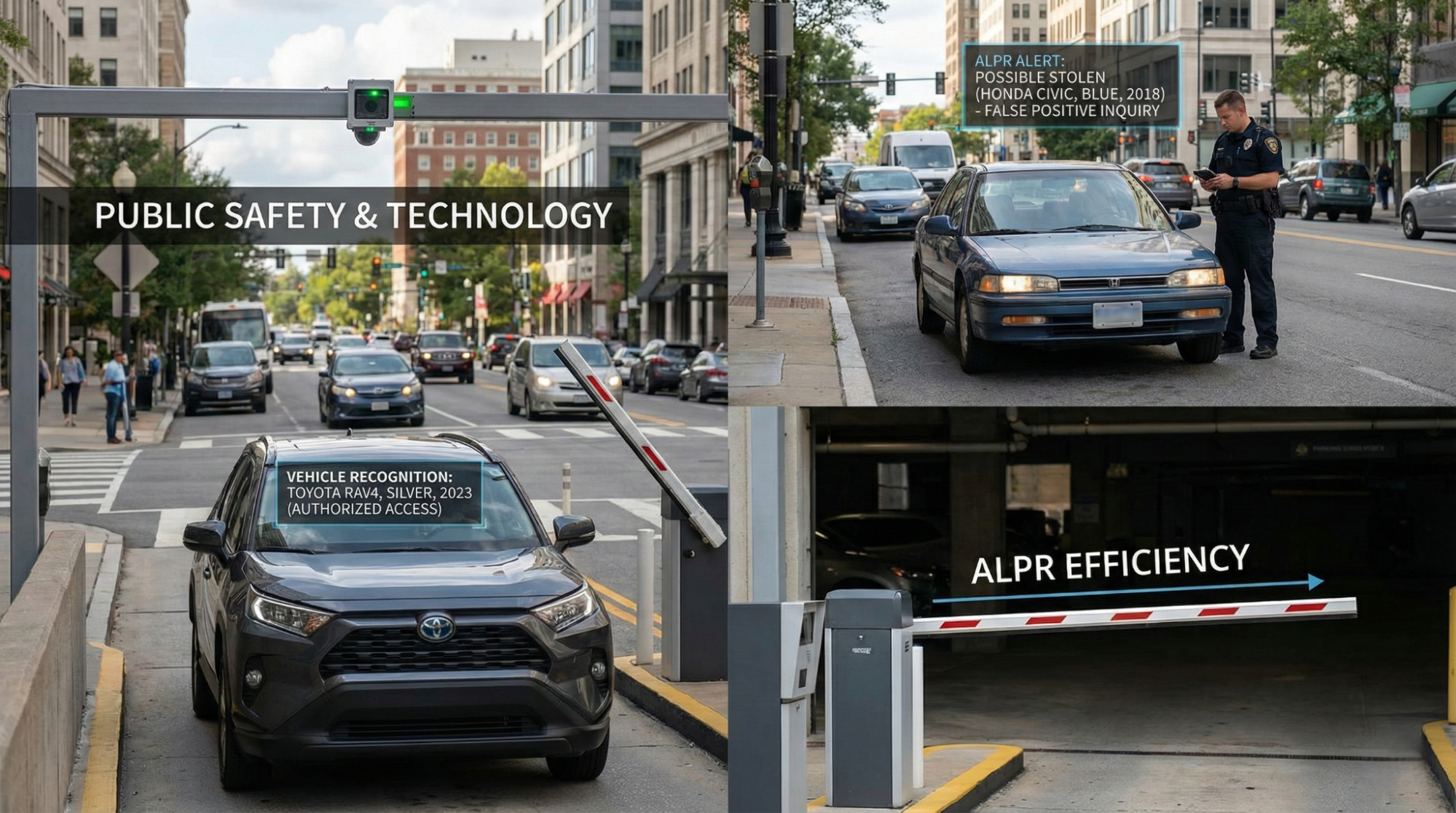
A collage illustrating public safety technology: a silver SUV receiving authorized access via vehicle recognition, a police officer investigating an ALPR stolen vehicle alert, and an automated gate demonstrating ALPR efficiency
Today’s systems do much more than read numbers. They identify a car’s make, model, colour and generation (MMCG) in milliseconds, yet they can still trigger false alarms that erode public trust. Understanding where vehicle classification models excel and where they fall short is critical for public safety agencies, parking operators and anyone who cares about privacy.
Why Vehicle Classification Models Matter
ALPR Adoption Is Widespread
ALPR is no longer a niche technology. By 2020, about 65 % of local police departments in the United States reported using it, and a 2022 survey of chiefs of police found roughly 40 % of U.S. agencies employing some form of ALPR.
Why Plate Reading Alone Is Not Enough
Falling costs have allowed even small departments to deploy fixed cameras that scan thousands of plates each day. While simple optical character recognition can flag a plate, sophisticated classification enhances context: it recognizes the vehicle’s brand, body style, colour and generation, enabling officers to verify hits and filter out mismatches. This richer picture is essential when multiple vehicles share similar plates or when a license plate is obscured.
How MMCG Improves Context and Accuracy
The importance of classification extends beyond law enforcement. Parking operators use make and model data to tailor loyalty programs, differentiate between commercial vans and private cars and enforce permit rules. Retailers and advertisers dream of segmenting customers by vehicle type to deliver personalised offers. Developers building smart‑city apps need reliable vehicle attributes to optimise traffic flows. Without accurate classification, these applications either don’t work or become intrusive because they rely solely on plate data.
How ALPR and MMCG Work in Practice
Step 1: Image Capture
At its core, ALPR pairs high‑speed cameras with AI software. Cameras mounted on poles, patrol cars or entry gates capture images of passing vehicles. The software isolates the plate region, applies character recognition to read alphanumeric symbols and then uses convolutional neural networks to extract features like logos, grille shapes and paint colour that reveal the make and model. The system also logs contextual data such as location, date and time; according to a Colorado state briefing, the captured data is anonymous and does not include personal details about occupants. Modern pipelines run this entire process in under a second.
Step 2: Plate Detection and OCR
Early generations of ALPR relied on fixed templates and struggled with dirty plates, angled views or custom fonts. Today’s deep learning models adapt to varied lighting and weather. They treat each frame as a grid of pixels and learn patterns that distinguish a 2023 Toyota Corolla from a 2021 Honda Civic.
Sighthound’s How ALPR Works article explains that modern systems decouple intelligence from hardware: inference runs on edge devices and can differentiate a bumper sticker from a plate, identify subtle variations between models and flag the colour and generation without sending data to the cloud.
Step 3: Vehicle Feature Extraction
MMCG recognition adds an extra layer of verification. Instead of alerting on a license number alone, the system cross‑checks the plate with the expected make and model in the hotlist. Sighthound’s law enforcement platform captures plate data and vehicle details and cross‑matches them against hotlists to generate real‑time alerts.
How MMCG Reduces False Positives
In practice, if a stolen vehicle is a blue Ford F‑150, the system will ignore a hit on a silver sedan with the same plate characters. That reduces false positives and speeds response times.
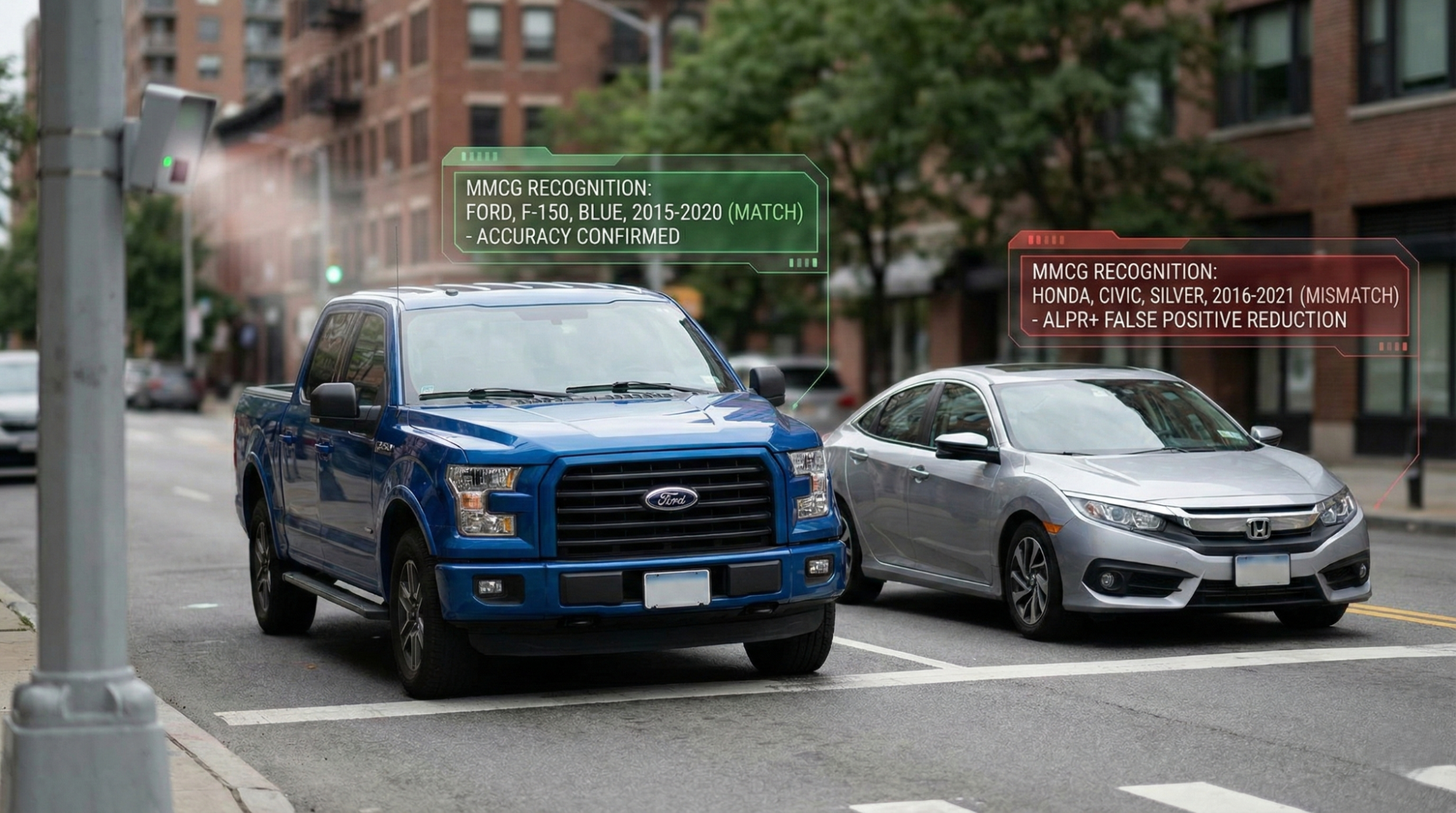
A side-by-side comparison of AI vehicle recognition on a city street: a blue Ford F-150 correctly matched with accuracy confirmed, and a silver Honda Civic identified as a mismatch to demonstrate ALPR+ false positive reduction
The Rise of Deep Learning in Vehicle Classification
Why Older Datasets Failed
As vehicle inventories diversify and markets globalise, fine‑grained classification demands bigger datasets and smarter algorithms. Traditional benchmarks like Stanford Cars cover 196 categories and are limited to U.S. models.
Large-Scale Datasets Like Car-1000
To push boundaries, researchers created Car‑1000, a dataset of 140,312 images spanning 1,000 models from 165 automakers. It uses a hierarchical label system with seven primary and 21 secondary categories, reflecting real‑world distinctions between sedans, hatchbacks and SUVs.
Regional Datasets Like VMMR Pakistan
Another dataset, VMMR Pakistan, collects 129,000 images across 94 vehicle classes captured from overhead cameras in unstructured traffic; models trained on this dataset achieved 97.3 % accuracy.
Multi-Sensor Fusion with LiDAR
Datasets alone are not enough. A 2024 preprint describes an intelligent toll‑collection system combining deep convolutional networks with LiDAR sensors to improve robustness.
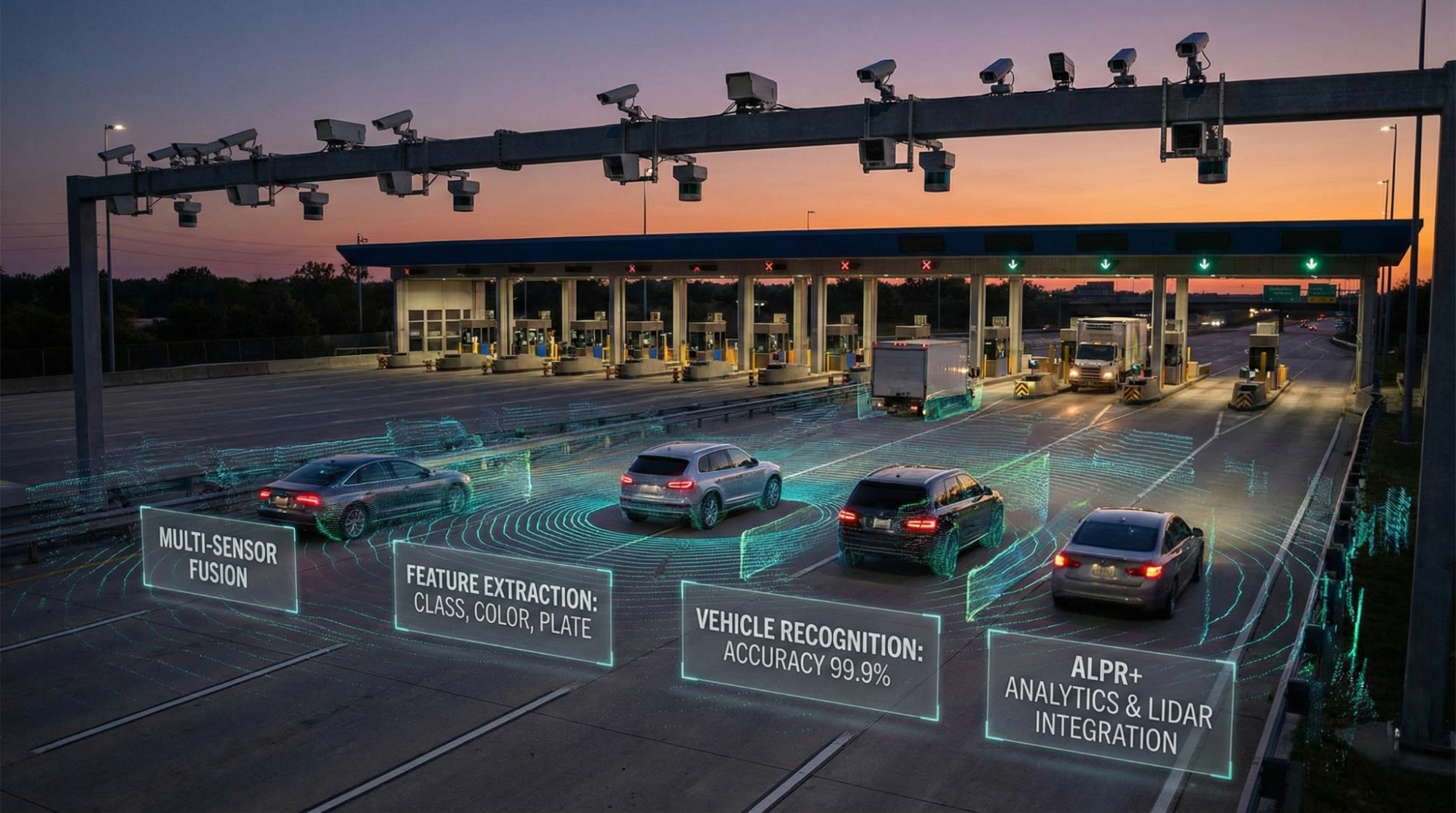
A wide-angle view of a highway toll plaza at sunset featuring an overhead sensor gantry with multiple cameras. Digital overlays show real-time vehicle recognition with 99.9% accuracy, multi-sensor fusion, and LiDAR integration for feature extraction on passing cars
LiDAR captures three‑dimensional contours and distances, complementing camera images when light conditions are poor. The study highlights challenges such as designing models that extract both global and local features, fusing modalities and building large annotated datasets. Another paper introduces VehiClassNet, a fine‑grained model that uses multi‑scale feature extraction and attention mechanisms to deliver high accuracy on the Cars‑196 dataset. These advances show that combining sensors and sophisticated networks can distinguish vehicles that look nearly identical to the human eye.
Why Model Architecture and Training Data Must Evolve Together
In practice, multi‑sensor fusion means deploying additional hardware like LiDAR or radar near camera locations. The extra cost may be justified in toll booths or border crossings where misclassification has financial or security consequences. For parking or retail analytics, camera‑only models with larger datasets may suffice. The key takeaway is that model architecture and training data must evolve together. Small, outdated datasets lead to poor generalisation; multi‑modal inputs and diverse training images produce resilient classification models.
Real-World Use Cases of Advanced Vehicle Classification
The biggest impact of advanced vehicle classification is operational. Fixed ALPR cameras can scan thousands of plates per day and feed the results to central databases.
Law Enforcement Applications
In Sacramento, ALPR data helped investigators reconstruct the route of a vehicle involved in a triple homicide, leading to a swift arrest.
In Georgia, police intercepted a child‑abduction suspect within minutes when an ALPR alert flashed on the dashboard.
These cases show how real‑time analytics augment human situational awareness and accelerate response.
Parking Management and Revenue Optimization
Beyond policing, vehicle analytics streamline parking management and urban mobility. Sighthound’s article on effective parking management with ALPR explains how MMCG recognition helps parking garages assign spaces, manage permits and offer personalized experiences.
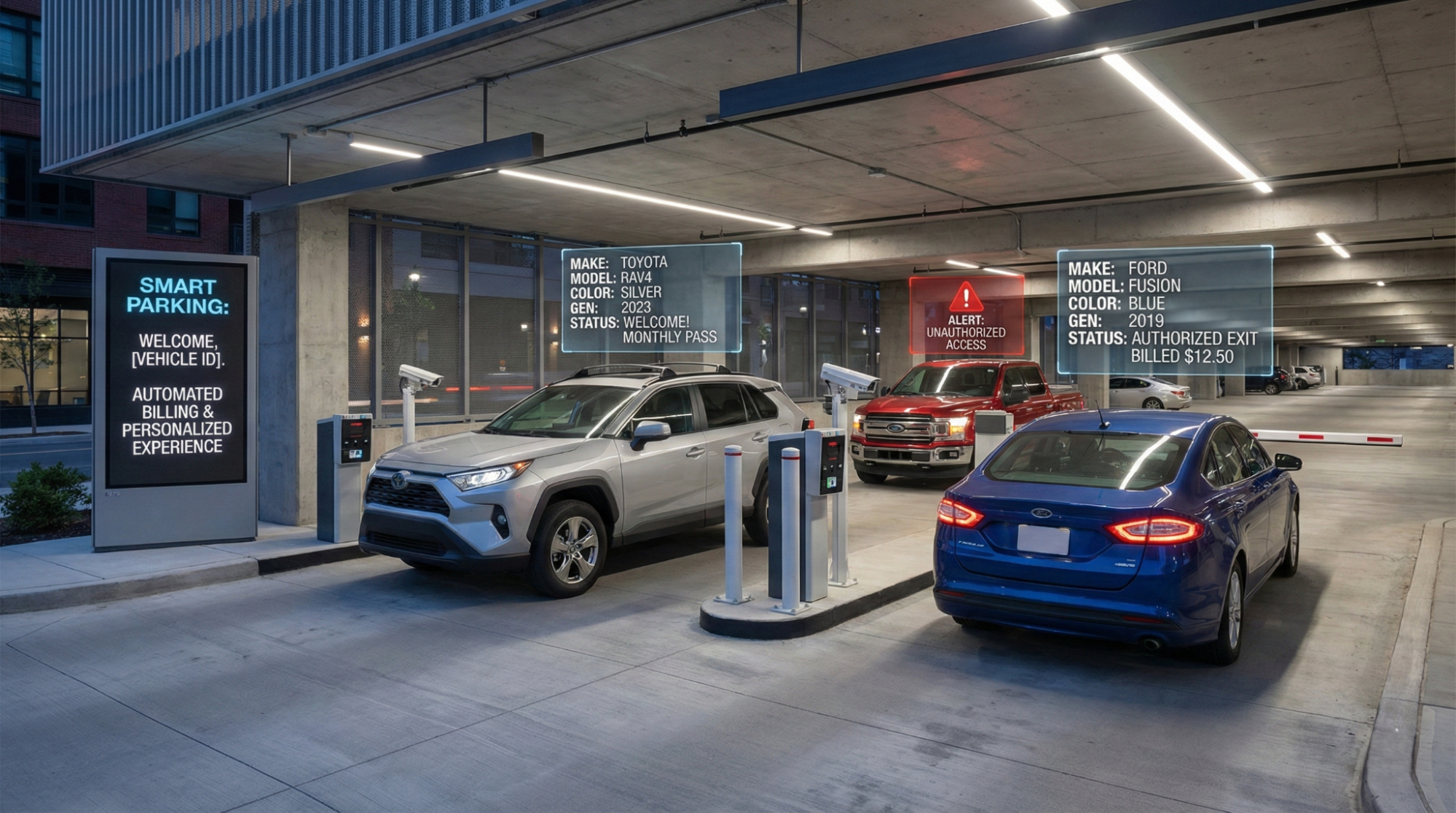
An indoor parking garage featuring a smart parking system with AI overlays. A silver Toyota RAV4 is recognized with a monthly pass, a blue Ford Fusion is shown with an automated exit bill of $12.50, and a red truck is flagged with an "Unauthorized Access" alert
For example, regular customers driving a black SUV might receive a tailored welcome message or special discount while unauthorized vehicles trigger alerts.
For parking operators, automating entry and exit reduces staffing costs and eliminates ticket fraud. Real‑time billing ensures that every vehicle pays for its stay.
Restaurants and retailers can segment visitors by vehicle type, delivering targeted offers to pickup locations or digital signage.
Smart City Traffic Optimization
In a smart‑city context, city planners use aggregated vehicle data to understand traffic patterns and adjust signal timings.
Theft Reduction and Hotlist Alerts
ALPR systems can also reduce theft and improve revenue. Colorado reported a 17% drop in motor vehicle theft rates after implementing ALPR and hotlist alerts.
The same infrastructure can support toll collection, access control at campuses and even drone‑based surveillance for perimeter security.
Privacy and Compliance Risks of ALPR Systems
Public Trust Is Context-Dependent
With greater capability comes greater scrutiny. The same system that catches a thief can create a detailed map of an individual’s movements. A Colorado briefing acknowledges that support for ALPR is context‑dependent: people are more comfortable using it to find stolen cars than to enforce minor violations, and those with more knowledge of ALPR often report lower trust in law enforcement. The report warns that ALPR data can track a person’s daily routine over months if retention limits are lax, and that policies vary widely between jurisdictions.
Documented Error Rates in ALPR
Error rates complicate privacy debates.
An ACLU of Iowa report found that around one in ten ALPR readings contain an error.
Independent testing by security researchers showed that some safety cameras misread the state on about 10% of plates and sometimes logged vehicle characteristics incorrectly.
Real-World Misidentification Incidents
Real‑world misreads have led to traumatic encounters: in Colorado, police detained Brittney Gilliam’s family at gunpoint after a system mistook their SUV for a stolen motorcycle.
In another case, an officer pulled over a vehicle because the system misread a “3” as a “7”. Misclassification can therefore expose innocent people to danger and legal risk.
Why Data Governance Is Critical
Data governance is critical. Agencies must decide how long to keep ALPR data, who can access it and under what circumstances. Without clear policies, the information can be misused for unauthorised surveillance or sold to data brokers.
Transparency about retention periods, audit trails and oversight mechanisms helps build public trust. Vendors that support offline‑first operation, where data stays on local hardware unless explicitly transmitted, give customers more control.
Where Most Vehicle Classification Systems Fail
Environmental and Visual Challenges
Despite advances, many vehicle classification solutions fall short in real‑world conditions. Misreads occur because plates are obscured by dirt, snow or tow bars; fonts and state logos vary widely; and lighting conditions change hourly. Many models are trained on idealised datasets with front or rear views and do not account for side angles or overhead perspectives. When a system sees a dirty plate or a non‑standard font, it may guess incorrectly. Plate misreads show that even commercially deployed systems struggle to differentiate state names and misattribute vehicle characteristics.
Dataset Bias and Regional Blind Spots
Another common failure is dataset bias. Models trained primarily on vehicles from one region may misclassify vehicles from another. The growth of Car‑1000 and VMMR Pakistan highlights the need to include diverse makes and driving conditions.
Operational Failures in Sensors or Hotlist Management
Systems that rely solely on optical sensors can fail at night or in fog; adding LiDAR or radar improves robustness but increases cost.
Finally, many organisations underestimate the operational complexity of managing hotlists. Out‑of‑date hotlists generate false alerts; poorly trained personnel may act on unverified hits. A false alert can lead to dangerous stops and potential liability.
How to Evaluate a Vehicle Classification System
Selecting the right solution requires more than comparing vendor brochures. Consider the following factors before committing:
Dataset coverage: Ask vendors what datasets their models are trained on. Diverse training data, including regional vehicles and different viewing angles, improves generalisation.
Sensor support: Determine whether the system uses optical cameras alone or supports LiDAR, infrared or radar. Multi‑sensor fusion can improve accuracy in challenging conditions.
MMCG depth: Verify that the system recognises make, model, colour and generation, not just the plate. MMCG recognition reduces false positives and enhances filtering.
Edge processing: Choose solutions that perform inference locally and offer offline‑first operation to retain control over sensitive data.
Hotlist integration: Assess how hotlists are updated and integrated. Reliable alerting depends on accurate lists and real‑time cross‑matching.
Governance controls: Look for tools that support data retention policies, audit logs and access controls. Transparent governance builds public trust.
False positive mitigation: Ask about false‑positive rates and how the vendor mitigates misreads. Request case studies or independent test results demonstrating performance.
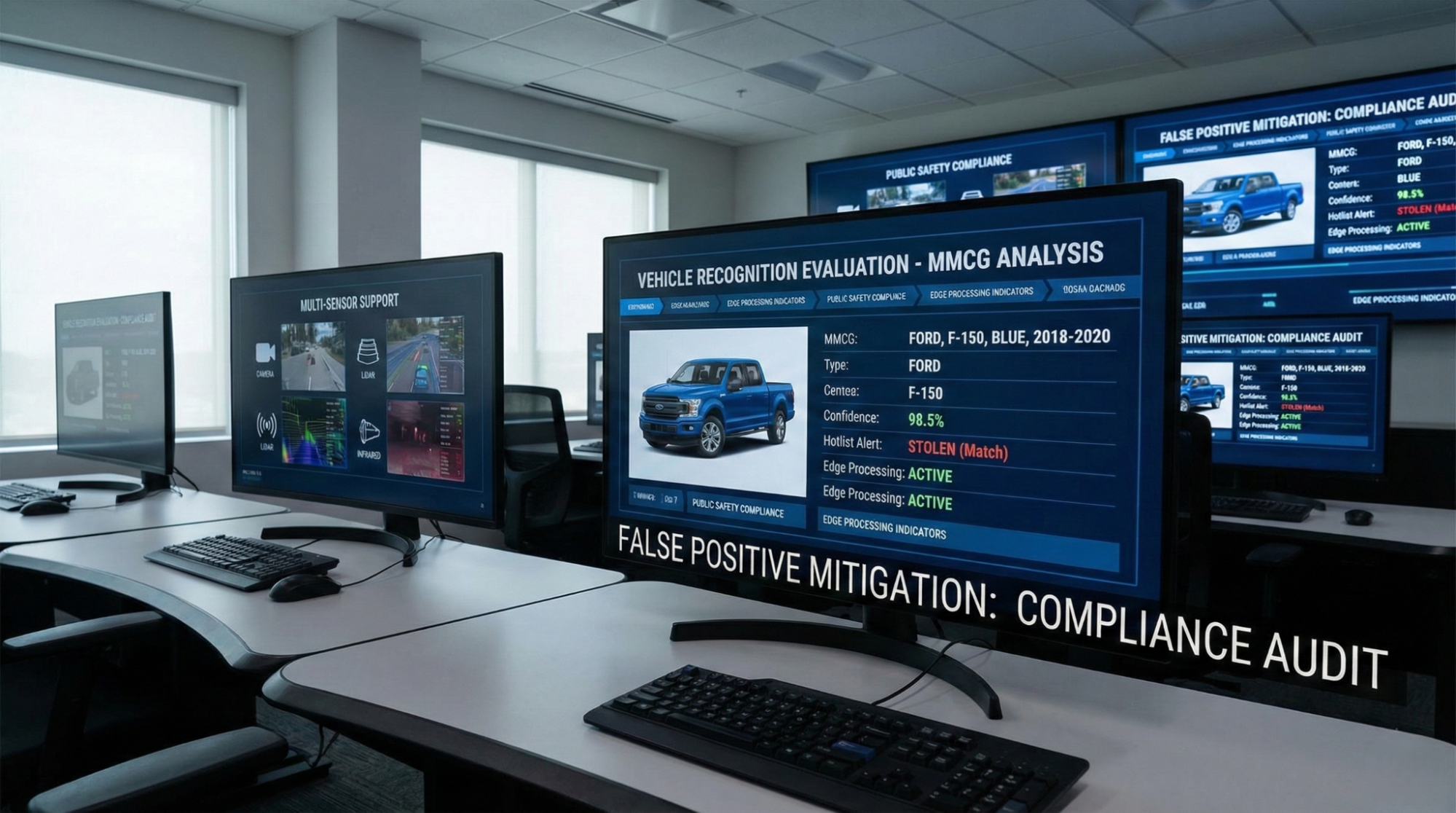
A high-tech security operations center featuring monitors displaying "MMCG Analysis" for vehicle recognition evaluation. The screens show a stolen vehicle match for a blue Ford F-150 with a 98.5% confidence rating and a prominent "False Positive Mitigation: Compliance Audit" banner
By evaluating these criteria, agencies and businesses can avoid common pitfalls and choose systems that align with operational goals and legal obligations.
Sighthound ALPR+ and MMCG Capabilities
What the Platform Includes
Sighthound has built its ALPR+ platform around the principles outlined above. The system combines object detection and tracking, vehicle type and orientation identification, license plate recognition and detailed vehicle analytics including make, model, colour and generation.
Offline-First Architecture
Its Gen 6 AI processes more than a billion images annually and delivers up to 160 frames per second on GPU hardware. Importantly, Sighthound offers an offline‑first architecture: agencies can deploy the system on their own servers or edge devices and retain full control over data.
Reducing False Positives with Cross-Matching
For law enforcement, Sighthound provides real‑time alerts when plates or vehicle attributes match entries in a hotlist. The platform cross‑matches not just plates but also make, model, colour and generation to reduce false positives.
For parking operators and smart‑city projects, the blog on effective parking management explains how MMCG recognition improves user experience and revenue.
How to Test the System
If you want to explore the product’s capabilities, the Sighthound ALPR+ product page outlines core features, including high‑accuracy detection, orientation analysis and flexible deployment options.
You can test the technology via the ALPR+ online demo, which allows you to upload images and see MMCG recognition in action.
Next Steps Before Deploying Vehicle Classification Technology
If you are considering vehicle classification technology, take a structured approach:
Define your operational goal: Clarify whether you need basic plate reading, MMCG recognition or fine‑grained multi‑sensor classification. Align the technology with your operational goals.
Run a controlled pilot: Deploy cameras in a limited area, collect data and measure false‑positive and false‑negative rates. Compare performance across different lighting and weather conditions.
Build governance policies: Establish retention policies, define access permissions and create an audit process. Public trust depends on transparent data management.
Choose edge‑ready architecture: Opt for solutions that can run on local servers or embedded devices and support offline‑first operation to protect privacy.
Train your team: Provide comprehensive training on verifying alerts, updating hotlists and handling misreads.
Engage stakeholders: Involve community leaders and legal counsel when deploying ALPR to address concerns, clarify benefits and ensure compliance with laws.
Monitor and upgrade: Keep abreast of new datasets and multi‑sensor research; as models improve, revisit your system choices and upgrade when necessary.
The next generation of vehicle classification promises greater accuracy and richer insights, but it will only succeed if organisations pair advanced technology with thoughtful policies and stakeholder engagement.
Sighthound’s products demonstrate what’s possible when AI meets real‑world constraints. To see for yourself, test the ALPR+ online demo.
FAQs:
-
MMCG stands for Make, Model, Color, and Generation.
In vehicle recognition systems, MMCG refers to the ability to identify not just a license plate number, but also the vehicle’s manufacturer, specific model, paint color, and model generation.
For example, instead of identifying only “ABC-1234,” the system can determine that the vehicle is a blue 2022 Ford F-150 (14th generation). This added context improves verification and reduces false alerts.
-
Accuracy varies depending on:
Dataset diversity
Lighting and weather conditions
Camera angle
Sensor type
Model architecture
In controlled academic benchmarks, fine-grained models have reported accuracy above 95 percent.
In real-world deployments, accuracy can drop due to environmental factors such as dirt, snow, glare, or occlusion. Systems that combine plate reading with MMCG cross-matching typically reduce false positives compared to plate-only detection.
-
ALPR focuses on reading the license plate characters using optical character recognition.
Vehicle classification identifies vehicle attributes, such as:
Make
Model
Color
Generation
Body type
Modern systems combine both. Plate recognition answers “what is the plate number?” while classification answers “what vehicle is it?”
Together, they provide stronger verification and better filtering.
-
Yes.
Vehicle classification models can identify make, model, and color even when:
Plates are obscured
Plates are missing
Characters are unreadable
Plates are damaged
This is particularly useful in cases involving stolen vehicles, toll evasion, or incomplete plate captures.
However, classification alone does not uniquely identify a vehicle. It works best when combined with ALPR.
-
Common causes include:
Dirty or damaged plates
Custom fonts
Similar character shapes (e.g., 3 vs 8, O vs 0)
Poor lighting
Motion blur
Outdated hotlists
Adding MMCG cross-matching reduces the likelihood of acting on a misread plate.
-
Not necessarily.
Some systems perform inference locally on edge devices or on-premise servers.
Edge-based processing can:
Reduce latency
Improve reliability
Increase data control
Limit unnecessary data transmission
Cloud-based deployments may be used for centralized analytics, but they are not mandatory for classification.
-
They are trained using large image datasets containing labeled vehicles across:
Different makes and models
Multiple angles
Varied lighting conditions
Regional vehicle variations
Modern systems use deep convolutional neural networks and attention mechanisms to learn subtle differences between visually similar vehicles.
Some advanced deployments combine camera data with LiDAR or radar for improved robustness.