
Smart parking EV enforcement is becoming a computer vision problem
TL;DR:
EV charging bays fail under manual enforcement because every violation depends on these facts: patrols can't gather continuously which vehicle is in the bay, whether it's an EV, and how long it has stayed. Smart parking EV integration connects cameras to that policy layer. Sighthound Automatic License Plate Recognition (ALPR+) with make, model, color, and generation (MMCG) recognition supplies all three facts from existing cameras, processed at the edge.
This article is for informational purposes and is not legal advice. Consult your organization's counsel for guidance specific to your jurisdiction and workflow.
Key takeaways
EV space abuse, overstays, and unenforceable session limits are the three failure modes of manual EV parking enforcement.
Attribute-based vehicle identification (MMCG) distinguishes an electric vehicle from a gas vehicle even when the license plate is obscured or missing.
Sighthound provides the detection data; enforcement rules stay agency-defined and operator-managed, with no built-in rule engine implied.
Edge processing keeps plate and vehicle data inside the operator's network and keeps working at charging sites with unreliable connectivity.
Most operators can keep their existing RTSP cameras and upgrade the processing layer instead of the hardware.
Camera placement, deployment mode, integration path, and retention policy are the four evaluation criteria that decide whether a deployment succeeds.
What does smart parking EV integration actually mean?
Smart parking EV integration is the connection between vehicle identification and EV space policy. A camera watches the bay, a detection engine determines which vehicle is present and what kind of vehicle it is, and the operator's own rules decide what happens next: an alert, a fee, a gate action, or nothing.
The word that matters is integration. None of the pieces is new on its own. What's new is wiring them into one workflow so the enforcement decision happens automatically, at the space, as the violation occurs.
Four things get integrated:
Existing IP cameras covering the charging bays
A detection engine such as Sighthound ALPR+ that reads plates and vehicle attributes
The operator's policy layer: permits, session limits, pricing zones
Downstream parking, payment, or enforcement systems
Why is EV space enforcement harder than standard parking enforcement?
A standard parking violation needs one fact: is the vehicle allowed to be here? An EV bay violation needs three. Is a vehicle present, is it actually an EV, and has it exceeded its charging session?
Patrols can't answer those continuously. Sighthound's operational research documents the recurring abuse patterns: gas vehicles occupying charging spots (drivers call it ICE-ing), overstays that run long past the authorized charging duration, and a plain lack of dwell-time visibility. Session limits exist on paper only, because nobody enforces a 90-minute rule with a patrol that passes every 4 hours.
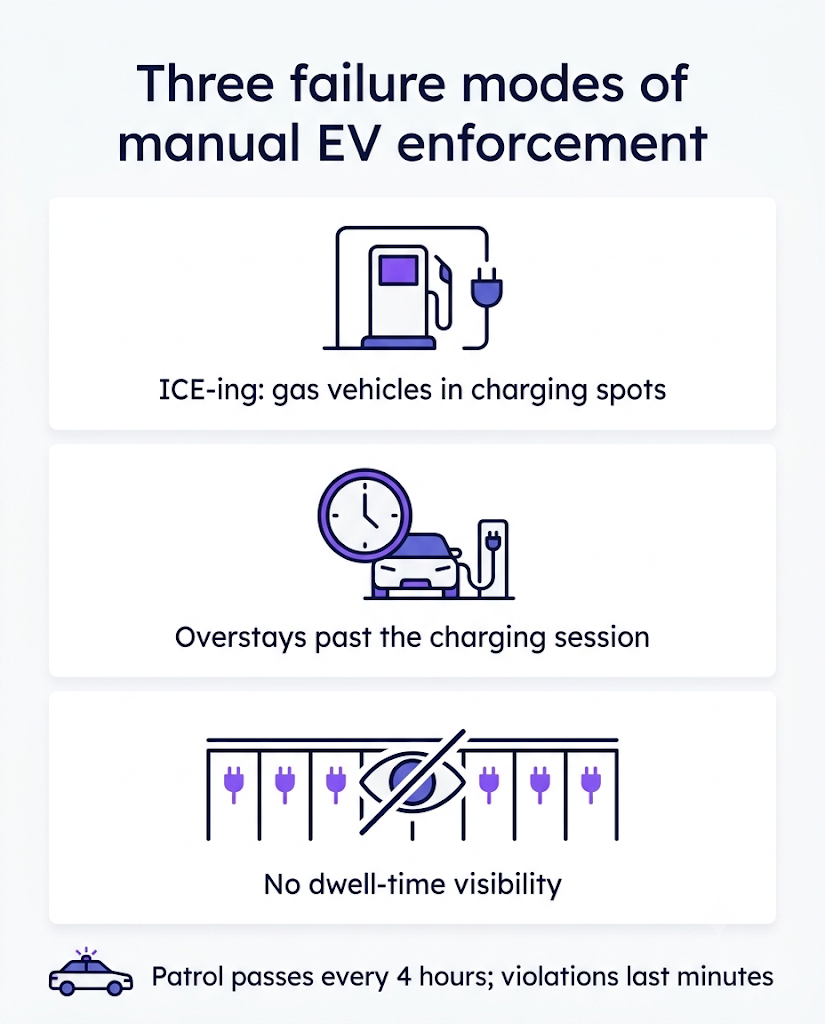
Infographic showing ICE-ing, overstays, and missing dwell-time visibility in EV parking.
Manual enforcement fails predictably: delayed response, coverage limited to wherever the patrol happens to be, and human error on plate reads.
The cost is concrete: lost charging revenue, a lost customer, and a utilization number that quietly gets worse.
How does computer vision detect EV space abuse?
Cameras feed a detection engine that reads the plate, extracts vehicle attributes, and tracks the vehicle over time. The operator's policy logic then decides whether that vehicle belongs in that bay right now.
The identification layer
Plate reading answers who the vehicle is. Attribute recognition answers what it is. Sighthound ALPR+ extracts make, model, color, and generation (MMCG) alongside the plate text, and that attribute layer is what makes EV enforcement workable. An EV can be identified by its make, model, and generation even when the plate is dirty, angled, or missing. Plates fail in exactly the conditions where enforcement matters most, so a system that depends only on plate text inherits those failures.
The tracking layer
Detection on a single frame proves presence. Tracking across frames proves duration. The pipeline, simplified:
An RTSP camera stream is ingested at the edge
The vehicle is detected and classified
The plate is detected and read, with a confidence score attached
MMCG attributes are extracted
The vehicle is tracked across frames for entry, exit, and dwell time
A structured JSON event is delivered to the operator's systems
Sighthound ALPR+ performs steps 2 through 6 and returns the results through a REST API, so output drops into the parking platform the operator already runs.
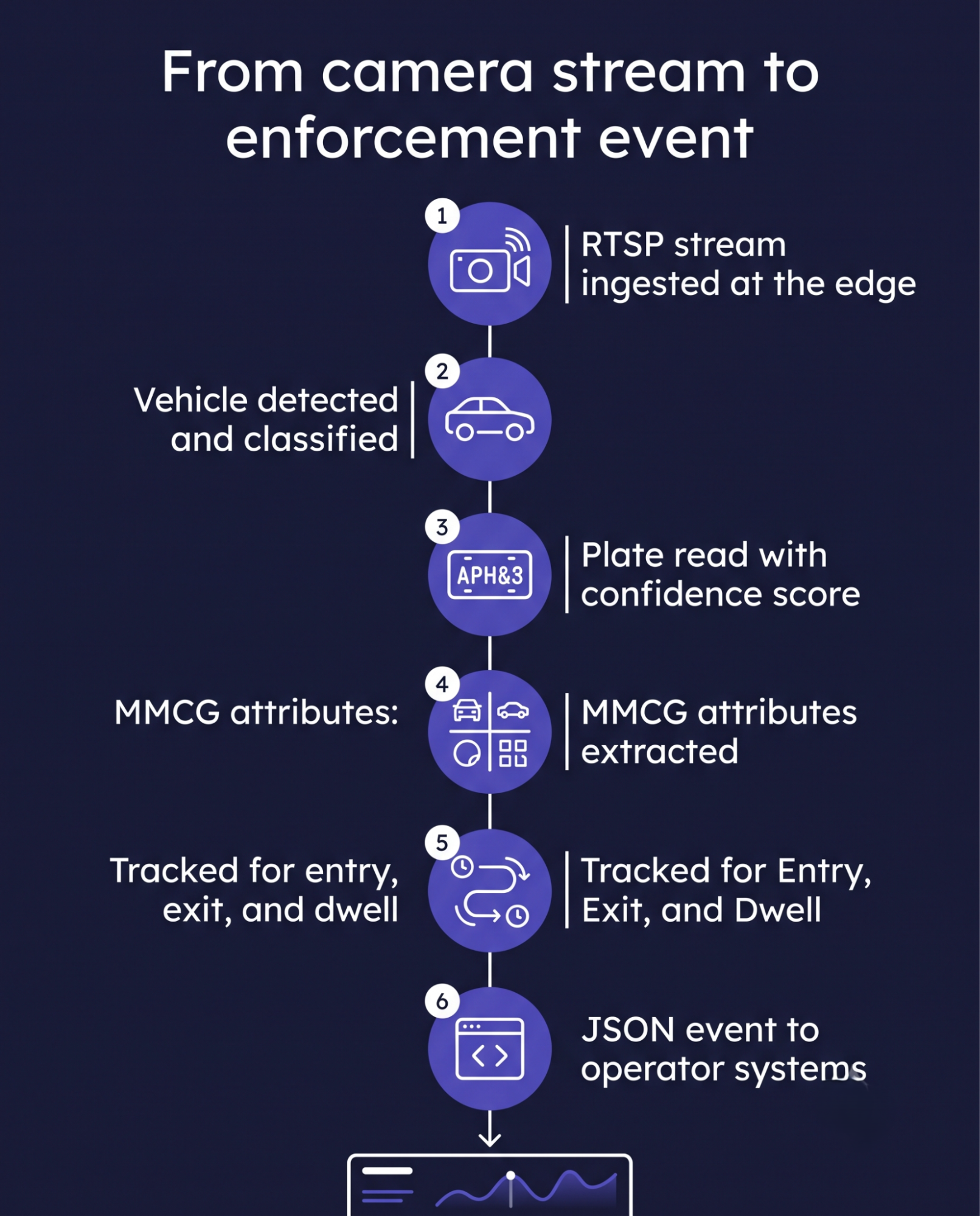
Six-step pipeline from camera stream to structured JSON enforcement event.
How do session timing and permit logic work with plate data?
Entry & exit correlation gives you dwell time per vehicle. Once the system knows a specific vehicle entered bay 4 at 2:11 pm, session timing stops being guesswork: a 90-minute limit becomes a timestamp comparison.
Permit logic works the same way. Hotlists and permit lists mark which plates or which vehicle profiles are authorized, and a mismatch generates an event. Overstay alerts, dwell thresholds, and dynamic pricing enforcement all run as agency-defined workflows on top of the same detection stream.
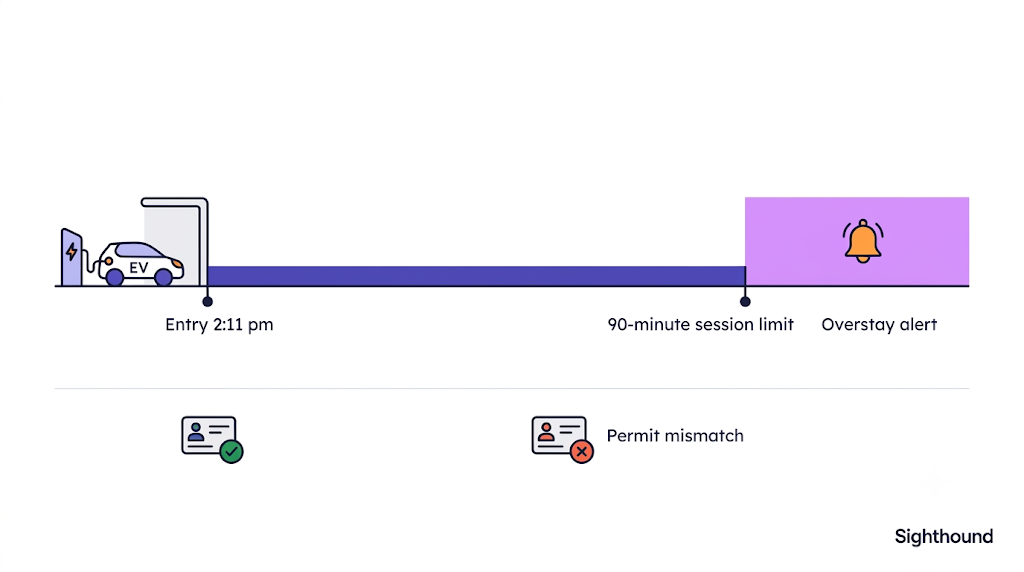
Timeline showing vehicle entry, session limit, overstay alert, and permit mismatch check.
One distinction matters here, and it's worth being precise about. Sighthound supplies the detection data: the plate, the attributes, the timestamps. The rules that act on that data are defined and managed by the agency or operator. There is no built-in citation engine, and pretending otherwise would misdescribe how these deployments actually work. Operators keep control of policy. The vision system keeps them informed.
Why does the enforcement decision belong at the edge?
Charging infrastructure gets installed where the parking is, and the parking is rarely where the bandwidth is. Edge processing handles video where it's generated, on a device sitting at the site, so the workflow keeps running when connectivity drops.
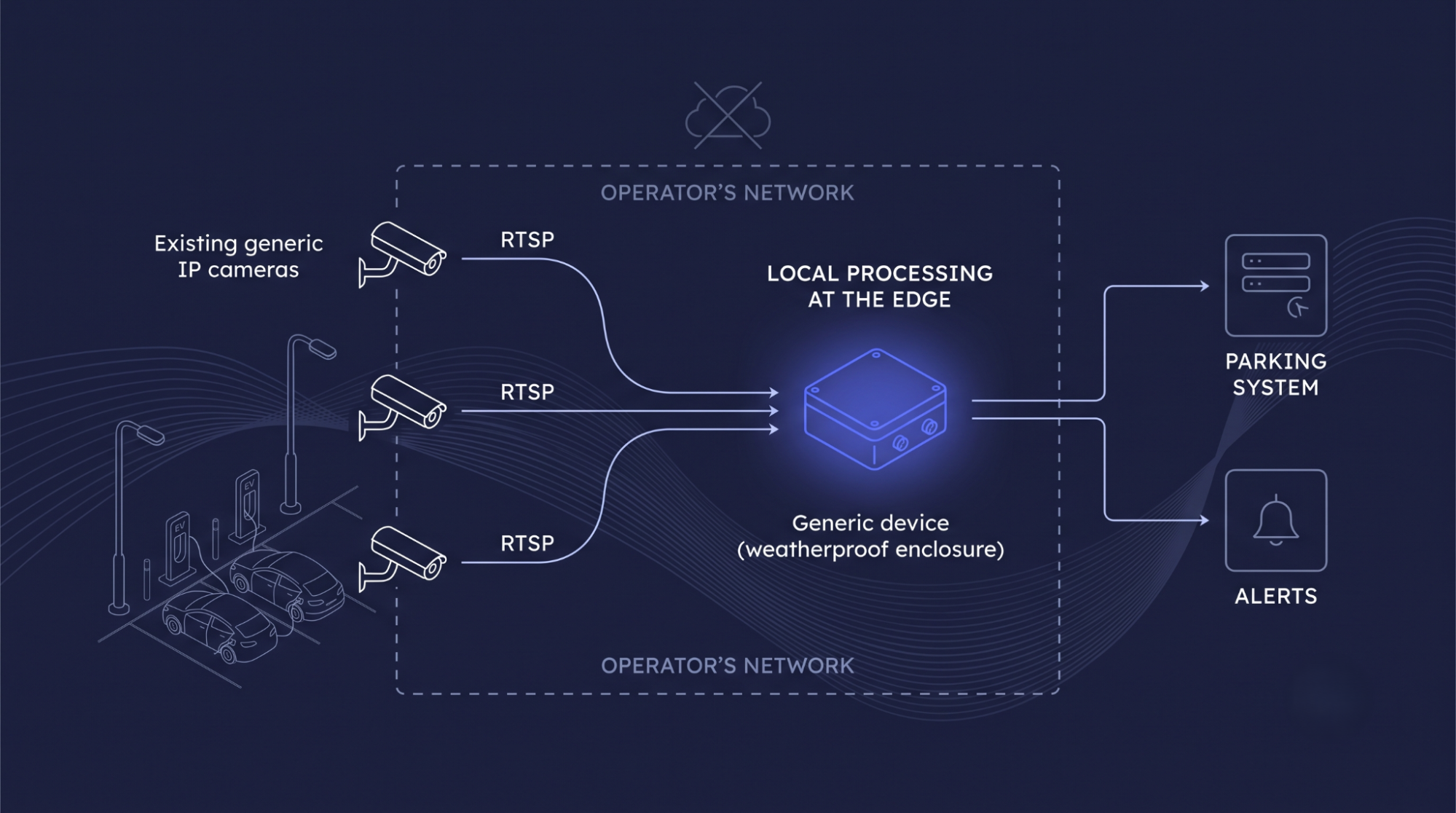
Diagram of cameras feeding a local edge device inside the operator's network.
It's also a stronger privacy posture. Plate reads, and vehicle attributes stay inside the operator's network instead of streaming to someone else's cloud. That supports privacy-aligned retention workflows, defining how long you keep detection data (30 to 90 days is a common range for operational logs) and confirming the policy against the privacy laws that apply to you
For ALPR+ running on edge hardware such as the Sighthound Compute Node, detection is real-time: the vehicle is identified while it's still in the bay, which is the only moment an enforcement decision is useful.
What should parking operators evaluate before deploying?
Four criteria separate deployments that work from deployments that stall:
Camera placement and image quality. Placement is the primary accuracy variable. Angle, height, and lighting decide more than any spec sheet.
Camera reuse. Confirm whether existing RTSP cameras can feed the detection engine. Most can, which changes the budget conversation.
Deployment mode.Edge device, on-prem server, or cloud. Sites with weak connectivity should default to edge.
Integration path and ownership. Detection events arrive as structured JSON over REST or message queues. Map where they land, and confirm your team owns the rule logic, because it does.
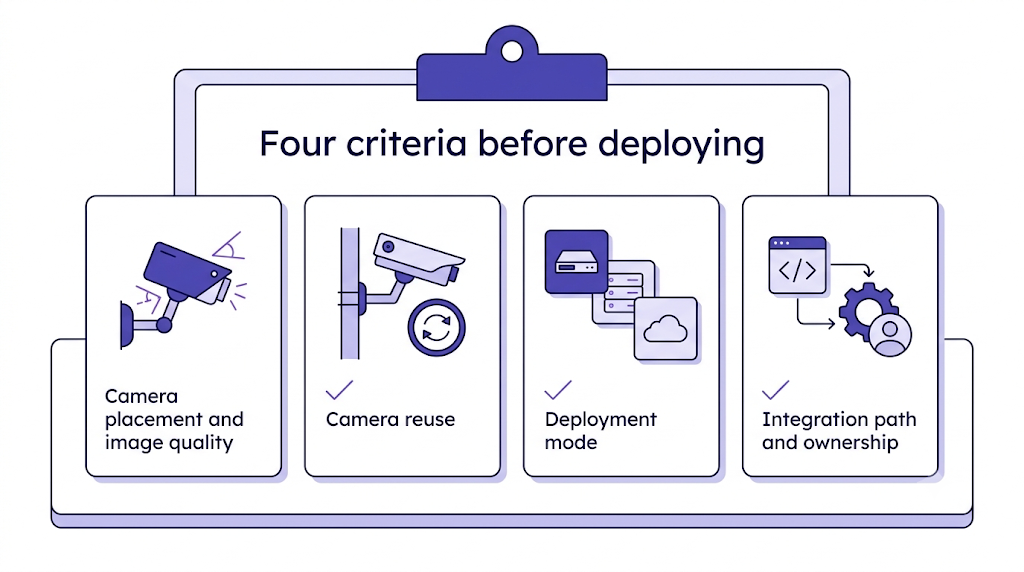
Four evaluation cards covering camera placement, reuse, deployment mode, and integration ownership.
How Sighthound ALPR+ and the Compute Node help
Sighthound ALPR+ reads license plates and extracts MMCG attributes from images or RTSP streams, returns structured JSON per detection, supports hotlist matching, and deploys as a Docker-based REST API at the edge, on-prem, or in the cloud.
Sighthound Compute Node runs that detection stack locally on existing camera streams, so charging sites get in-network, offline-capable processing without replacing a single camera.
Ready to put recognition at the edge? Request Compute Node with ALPR+ access and see how Sighthound Compute Node keeps gate response fast on your own lanes.For business opportunities, explore our Partner Program today.
-
Description text goes here
-
Description text goes here
-
Description text goes here