
TL;DR: On September 14, 2026, the International Association of Chiefs of Police (IACP) and 12 other law enforcement associations published 12 joint principles for automated license plate recognition (ALPR). They call for written policies covering access, documented queries, verification, training, retention, sharing, and data security. This crosswalk turns each principle into questions your policy should answer. Sighthound Retriever, powered by ALPR+, runs on agency hardware, but meeting the principles depends on agency policy.
“This article is for informational purposes and is not legal advice. Consult your organization's counsel for guidance specific to your jurisdiction and workflow.”
Key Takeaways
The September 14, 2026 joint principles were issued by 13 law enforcement associations, including IACP, and set a shared baseline for ALPR policy.
The principles call for every agency using ALPR to adopt written policies on uses, access, queries, verification, retention, sharing, security, and auditing.
The signatories state that ALPR identifies a vehicle and that a plate detection alone does not establish guilt or probable cause.
Each principle becomes a set of practical questions that an agency's own policy, training, and oversight process has to answer.
The principles leave retention periods to agencies and argue that access controls and auditing matter more than short deletion windows.
The principles name no vendors, and using any particular ALPR product does not by itself satisfy them.
An agency should start with its written policy and audit practice before evaluating whether its ALPR technology fits that policy.
What are the 2026 joint ALPR principles?
The joint principles are a model framework for law enforcement use of ALPR, released September 14, 2026. They were issued on behalf of 13 organizations, including the IACP, the National Sheriffs' Association, the Major County Sheriffs of America, the National District Attorneys Association, and the National Fusion Center Association (NFCA). Their stated aim is to support clear, enforceable agency policies.
The statement begins with a plain description of the technology. It says ALPR captures still images of vehicles and their visible plates, along with time and location, and can alert officers when a plate is linked to a stolen vehicle, a missing person, a warrant, or a crime. The signatories put the core limit in one line: "ALPR identifies a vehicle - not a person."
This post reads the September principles as a crosswalk of what each one asks for, and which questions your policy should answer. If you need a general policy-building walkthrough, start with our August ALPR policy checklist.
Why do the joint principles matter for agencies now?
The principles give agencies a shared reference point at a time of scrutiny. The signatories acknowledge recent concerns from communities and policymakers and say those concerns deserve clear answers and strong safeguards, including transparency, accountability, and consequences for misuse.

Empty council chamber with public-comment lectern and microphone in the foreground
The themes aren't new. A 2012 Department of Justice-funded study, Automated License Plate Recognition Systems Policy and Operational Guidance for Law Enforcement, surveyed 444 state, local, and tribal agencies in 2009, and 305 responded. Among the 40 agencies using ALPR that completed the detailed survey, fewer than half (48%) had an ALPR policy. That figure is more than a decade old and current practice may differ. Still, it shows how long written policy has been the open question.
What's new in 2026 is that 13 associations agreed on one list. For a records, IT, or program lead, the list works as a review template. You can check your current policy against each item and note the gaps.
How do the 12 principles translate into policy questions?
Each principle maps to a few questions your policy, training, and oversight should answer. The table paraphrases each principle from the joint statement. Read the original before you adopt any language.
| Principle | What it asks for (paraphrased) | Questions for your policy |
|---|---|---|
| Written policies | Clear written rules on uses, access, queries, verification, retention, sharing, security, auditing, accountability | Does one written policy cover all nine areas? Who owns it and how often is it reviewed? |
| Permitted uses | Use only by trained, authorized staff for legitimate public safety purposes | Which purposes are authorized? Which are explicitly excluded? |
| Authorized access | Strong access controls, routine audits, prompt removal when duties change | Who grants access? What triggers removal when someone changes roles? |
| Auditing and accountability | Access logs, routine audits, investigation of misuse, discipline, referral of criminal misuse | How often are audits run, and by whom? What is the discipline path? |
| Required training | Initial and ongoing training on uses, verification, privacy, security, consequences | What does initial training cover? How often is it refreshed? |
| Documented queries | Each query tied to a case number or other documented purpose, with logs kept | What counts as a documented purpose? Where are query records kept? |
| Verification of plate matches | Verify before enforcement action; an alert alone proves nothing about the driver | What steps confirm a match before an officer acts? |
| Confidentiality | Protect ALPR data from public disclosure, including data a private company holds for the agency | How does your public-records process treat ALPR data? What do vendor contracts say? |
| Meaningful retention | Keep data needed for investigations while protecting privacy and security | What retention period has your agency set, and on what basis? |
| Responsible data sharing | Share across jurisdictions only for legitimate purposes, with controls; never sell access | Which agencies may receive data? Who approves sharing and how is it recorded? |
| Access to non-governmental data | Same safeguards apply to commercial or private ALPR data | Does policy cover data your agency queries but didn't collect? |
| Data security | Strong security, access, and disclosure protections for anyone storing ALPR data | Where is the data stored? Who can reach it, inside and outside the agency? |
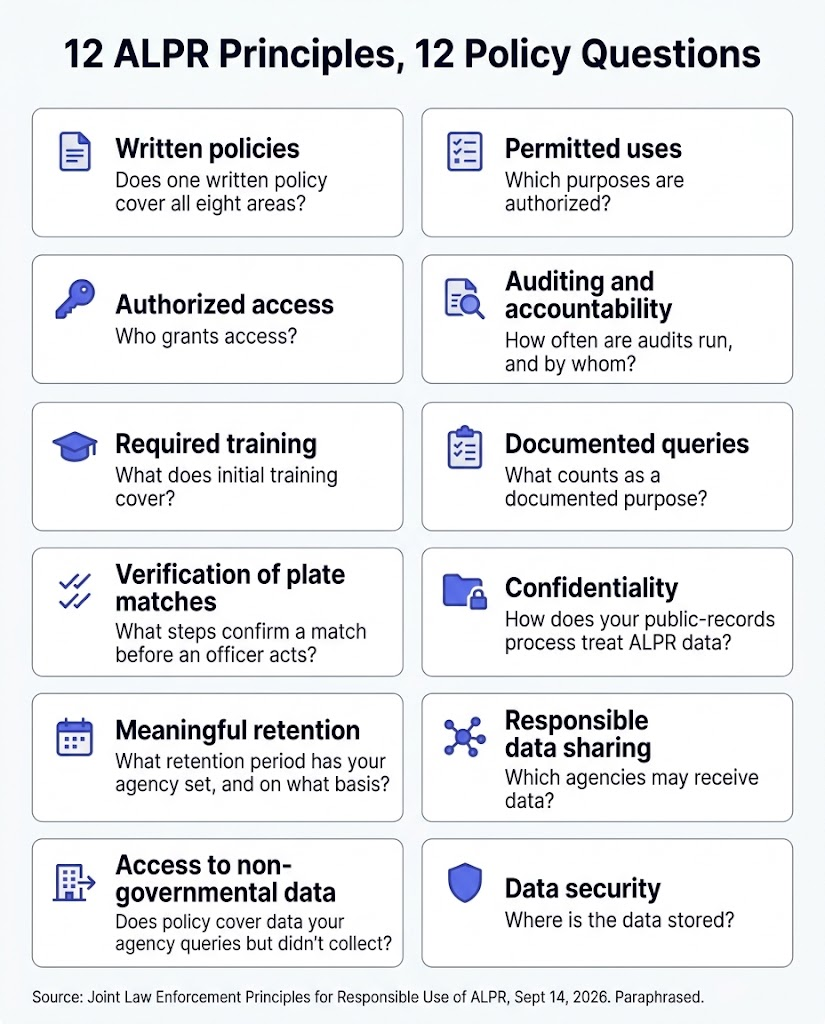
Grid infographic listing 12 joint ALPR principles, each paired with one agency policy question
Two rows deserve extra attention. On retention, the signatories argue that access controls, documented queries, and auditing protect against misuse better than deleting data after an arbitrarily short period, since a vehicle's significance may emerge weeks or months later. That is the signatories' position. They don't set a number, and the right period for your agency depends on your jurisdiction and counsel.
On confidentiality and security, the obligations reach past the agency. The principles say comparable protections must apply when a private company stores or manages ALPR data for a government agency. If a vendor holds any of your data, your contract and your policy both need to say how.
What do the principles say about verifying an alert?
The principles treat every alert as a lead. They state that a plate detection does not establish guilt, does not alone provide probable cause, and must be evaluated and verified before enforcement action.
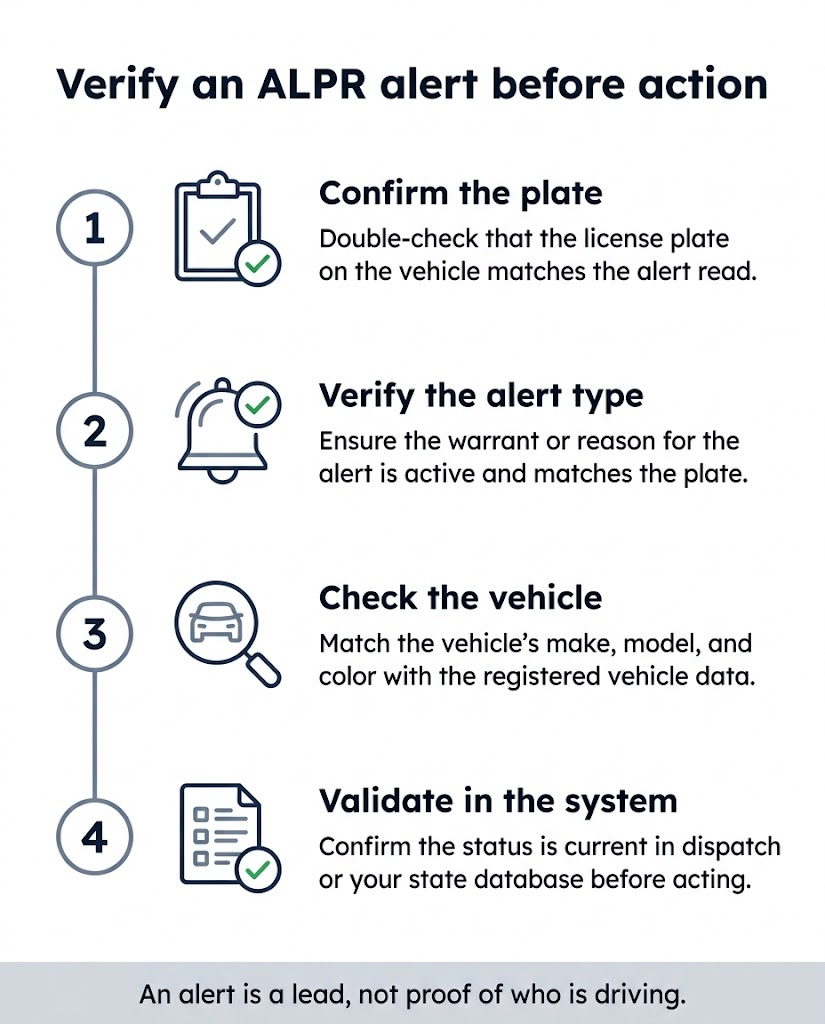
Four-step checklist for verifying an ALPR alert: plate, jurisdiction, record status, relevance
A practical verification step usually covers four checks:
Plate: Does the plate read match the captured image, character by character?
Jurisdiction: Is the plate from the state or province on the record?
Record status: Is the hotlist entry still active, or has the vehicle been recovered or the warrant cleared?
Relevance: Does the vehicle itself match the record?
The last check is where vehicle attributes help. If a record lists a gray sedan and the camera shows a pickup truck, something is wrong, whether that's a misread, a swapped plate, or a stale record. A make, model, color, and generation (MMCG) cross-check helps an officer ask "does the vehicle match the plate?" before acting. It is a cross-check and never proof of who is driving.
Where should an agency start its policy review?
Start with the document, then the practice, then the technology. The Department of Justice's License Plate Reader Policy Development Template remains a useful drafting aid. It covers collection, information quality, access and disclosure, redress, security, data retention and destruction, accountability, and training, with sample language for each provision. Check the template's publication date (February 2017) before relying on it. Parts may predate current state law.

Two people reviewing printed policy documents at a conference table with a highlighter
A workable sequence:
Map your current policy against the 12 principles. Use the table above and mark each row covered, partial, or missing.
Check practice against policy. Pull a sample of recent queries and confirm each one has a documented purpose.
Review access lists. Confirm every account belongs to someone whose current duties require it.
Review contracts. Confirm vendor agreements address storage, disclosure, and security for any ALPR data a vendor holds.
Bring counsel in on retention and sharing. These two areas depend most on jurisdiction.
Then evaluate technology. Ask whether your system's deployment and data handling fit the policy you've written.
How Sighthound Retriever helps
Sighthound Retriever, powered by ALPR+, is a browser-based license plate recognition product. The joint principles don't name or evaluate any vendor, and Retriever doesn't satisfy them on its own. The agency owns the policy, training, and oversight.
What Retriever does:
Runs on your hardware. Retriever runs on the agency's own hardware and doesn't require a cloud connection.
Keeps data under your policy. There is no default central or shared data pool. The agency chooses sharing and export under its own policy.
Records the vehicle with the plate. Each vehicle record can include the plate plus make, model, color, and generation (MMCG), which supports the "does the vehicle match the plate?" check described above.
Helps when the plate doesn't read. In rain, dust, darkness, or at a hard angle, the vehicle attributes still describe what passed the camera.
Connects to your systems. Agencies can connect results to their own systems through custom integration.
Sighthound is tooling software. Compliance depends on your environment, policies and controls. See it run on your own image.