
How Edge AI Helps Drones Identify Vehicles Without the Cloud
TL;DR
Edge AI lets drones identify vehicles quickly and privately without sending video to a remote server. By processing high‑resolution footage on‑device, drones overcome bandwidth limits, avoid latency and maintain situational awareness even when connectivity drops. Sighthound’s Compute hardware and ALPR+ software run license‑plate recognition and detailed vehicle analytics (make, model, color, and generation) at the edge, turning UAVs into real‑time enforcement tools.
Disclaimer: The information in this article is provided for general educational purposes and does not constitute legal advice. Readers should consult their own counsel about specific regulatory requirements.
Key Takeaways
Streaming video from a drone to the cloud consumes bandwidth and introduces latency; edge computing keeps data near the sensor so decisions happen in milliseconds.
U.S. drone rules limit operations to within the pilot’s visual line of sight and below 400 feet; drones can lose connectivity, so critical analytics must run locally.
Sighthound ALPR+ detects vehicles, tracks them, reads plates and extracts make, model, color and generation (MMCG) on‑device.
The Sighthound Compute Camera and Compute Node house an embedded NVIDIA GPU, high‑resolution sensors, PoE power and rugged IP67‑rated casings for real‑time AI without the cloud.
Running AI locally reduces network costs, protects privacy and keeps sensitive vehicle data inside the device, supporting compliance with regulations and FOIA requests.
A smart hardware/software stack enables drones to operate even in remote areas; when connectivity resumes, results sync to central systems for reporting.
Why can’t drones rely on cloud processing?
Flying drones over streets, parking lots or highways produces a torrent of high‑resolution video. Sending that stream to a remote server requires wide‑band wireless links and adds seconds of delay. In edge computing, computation happens close to the data source, a concept that reduces bandwidth consumption in backhaul links and is critical for real‑time applications such as autonomous vehicles and augmented reality. MIT researchers likewise note that running AI models directly on data at the edge reduces latency and cost and unlocks real‑time insights.
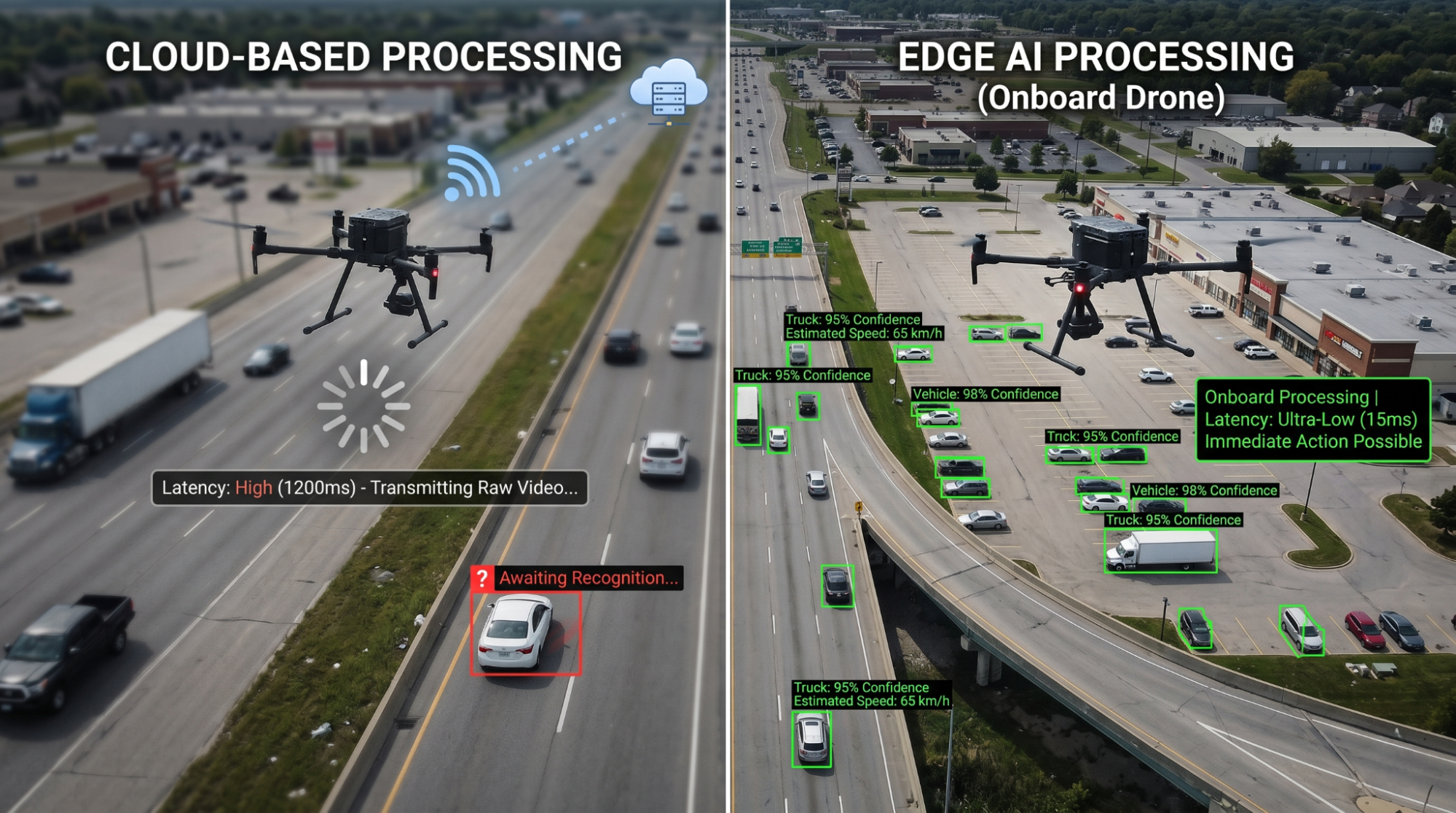
A side-by-side comparison of Cloud-based processing versus Edge AI processing on a drone. The Cloud side shows high latency (1200ms) with a "waiting" icon, while the Edge AI side shows ultra-low latency (15ms) with real-time vehicle detection and confidence scores
Drones often operate beyond reliable cell coverage or in congested RF environments. The FAA’s Public Safety Small Drone Playbook reminds recreational pilots to keep the drone within the pilot’s visual line of sight and to fly at or below 400 feet unless authorized. If communications drop, a cloud‑based analytics pipeline stops working just when situational awareness matters most. Edge AI enables the drone to continue identifying vehicles, logging evidence and raising alerts even without a network. Operators can sync results later, reducing dependence on long‑range bandwidth and avoiding costly data plans.
How does edge AI on drones identify vehicles?
Vehicle identification requires more than watching pixels; it combines object detection, tracking, license‑plate recognition and vehicle analytics. Sighthound ALPR+ uses AI algorithms to detect multiple objects like vehicles and people, track them in real time and read license plates. The system also provides detailed vehicle analytics by extracting make, model, color and generation (MMCG). These capabilities run at up to 160 FPS on a GPU or in real‑time on a CPU, enabling drones to follow vehicles smoothly and update their identities frame by frame.
For aerial patrols, the software processes a top‑down video feed and adjusts for perspective so that license plates and vehicle body lines remain legible. When a plate is visible, ALPR+ returns the alphanumeric string and region (state or country) with high accuracy. If a plate is obscured, the MMCG classifier still identifies the vehicle, ensuring that enforcement operations continue even when plates can’t be read. On‑device processing means that sensitive data never leaves the drone until you choose to transmit it.
What are the benefits of local processing for drones?
Processing data at the edge transforms drone operations. First, it eliminates round‑trip latency, allowing drones to flag stolen vehicles, overstays or lane violations in real time. Second, it slashes bandwidth usage; instead of streaming every frame, the drone transmits only event metadata or snapshots when needed. NIST researchers note that bringing computation and storage closer to end users reduces backhaul bandwidth and supports real‑time services. MIT experts add that running AI models at the edge reduces costs and delivers the real‑time insights that separate leaders from laggards.
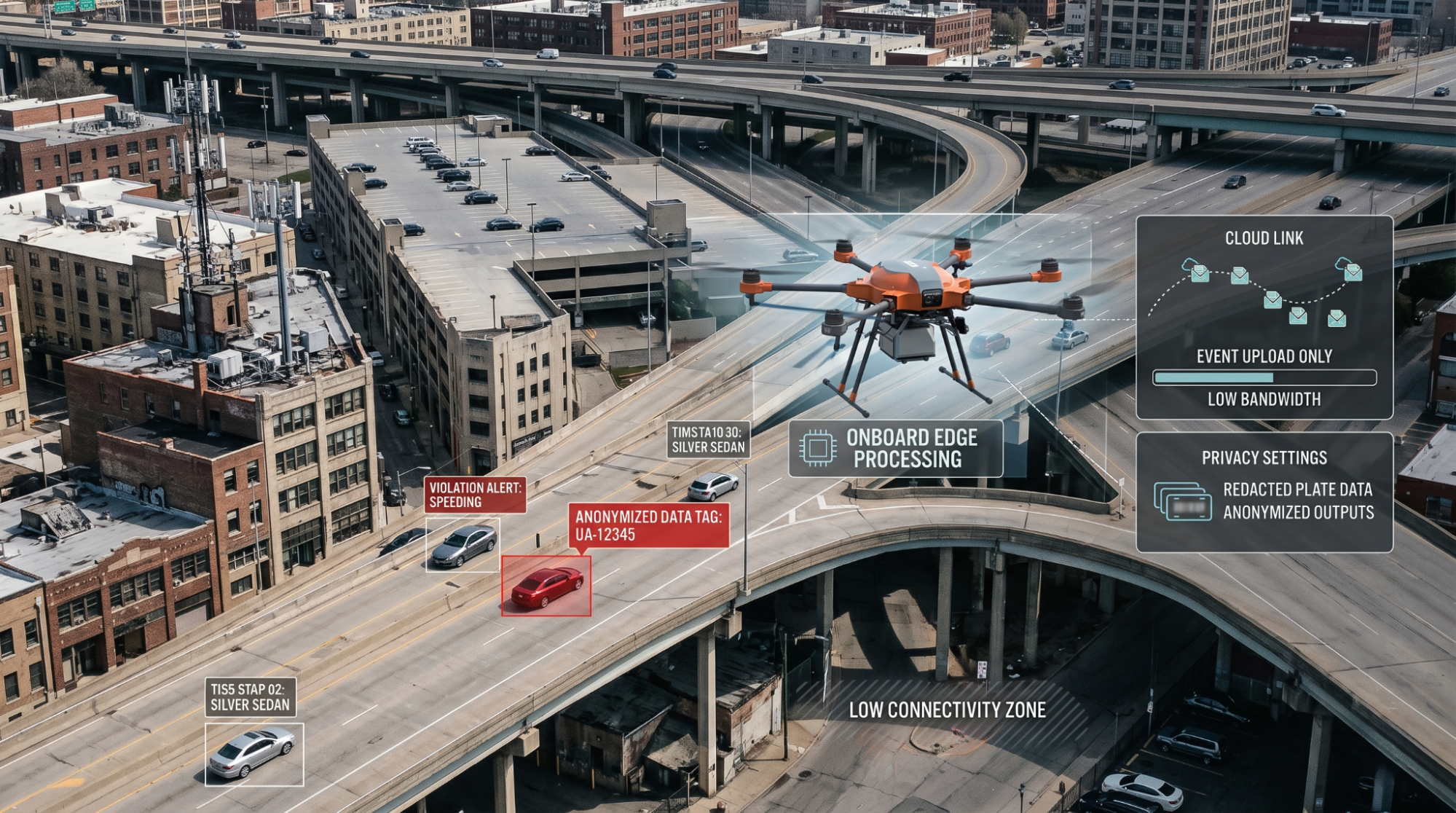
An orange surveillance drone performing onboard edge processing over a city highway. The graphic illustrates privacy features like redacted license plate data and anonymized data tags for vehicles, demonstrating secure traffic monitoring in a low connectivity zone
Local processing also enhances resilience. Drones used for parking enforcement or tolling often fly near buildings or under bridges where signals are weak. When analytics run locally, a momentary loss of connectivity doesn’t interrupt detection or evidence capture. Privacy improves as well: because video remains on‑device, only anonymized or redacted data is shared. For agencies subject to FOIA, having raw footage processed and stored locally simplifies compliance; sensitive information can be redacted before distribution using tools like Sighthound Redactor.
Which hardware and models suit edge drone analytics?
Edge AI requires hardware capable of running deep learning models in a small, rugged form factor. The Sighthound Compute Camera combines an 8.3 MP Sony STARVIS sensor, motorized zoom lenses, up to 4 TB NVMe storage and an embedded NVIDIA GPU in an IP67‑rated, passively cooled housing. It delivers real‑time ALPR+ and object detection without any external server, making it ideal for fixed installations or tethered drones.
For UAV integration, the Sighthound Compute Node provides a drop‑in edge compute module that works with any RTSP camera. Built on NVIDIA Orin NX or Orin Nano, it supports real‑time ALPR+ with MMCG, handles up to four video streams in super mode and requires no cloud connection. Both devices run Linux, are Docker‑ready, and integrate easily with third‑party systems via API. In the FAQ, Sighthound notes that its hardware processes data locally, minimizing latency and bandwidth while preserving offline capabilities.
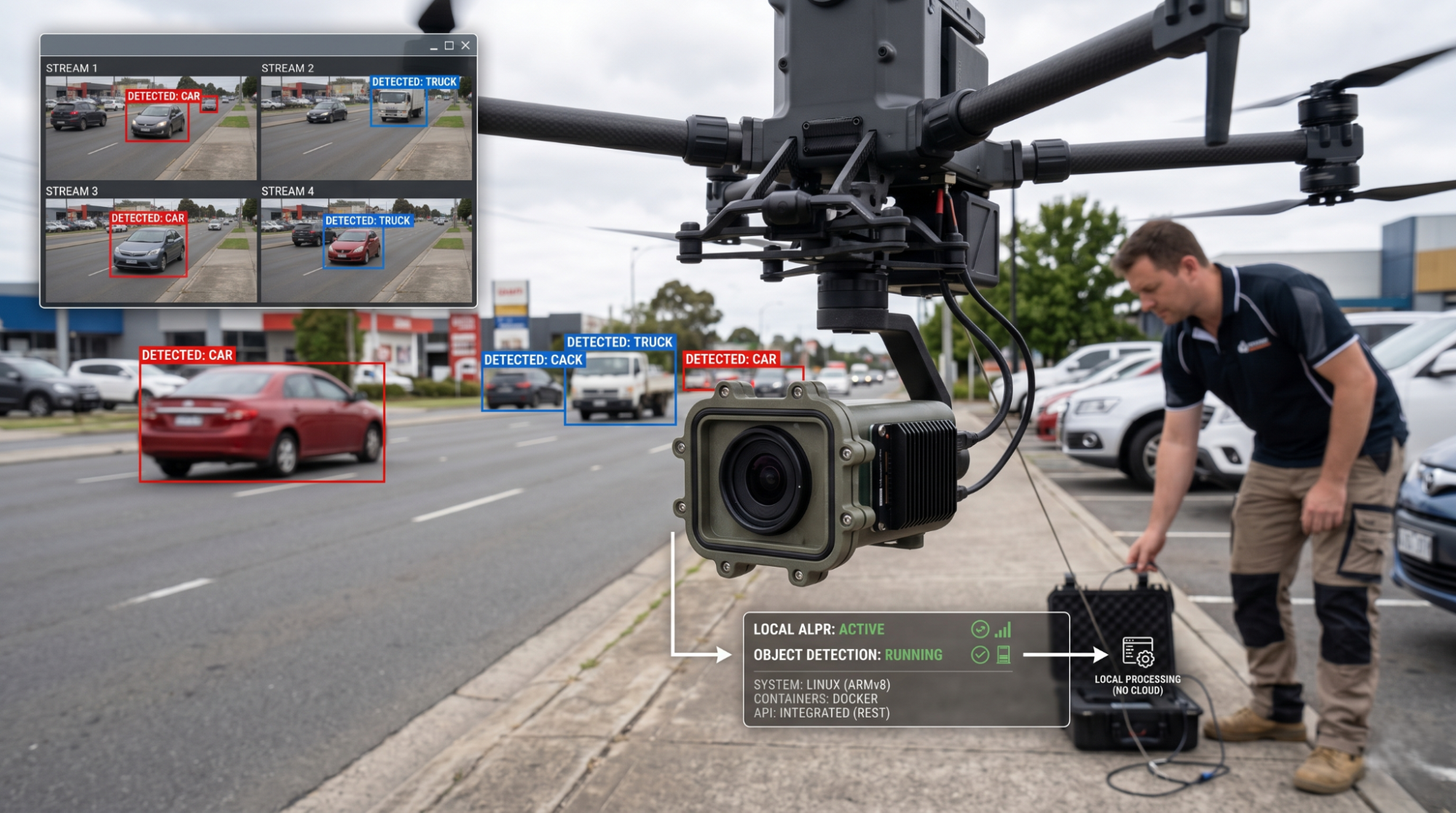
A technical breakdown of a drone's onboard AI system. An engineer works on a drone equipped with a localized camera system running Linux ARMv8 and Docker containers for real-time object detection and Local ALPR, labeled "Local Processing (No Cloud)
Together, these hardware options enable drones to perform vehicle detection and license‑plate recognition autonomously. Developers can deploy custom TensorFlow or PyTorch models on the same platform or leverage Sighthound’s pre‑trained models for MMCG and ALPR tasks. The modular design allows integrators to choose the right camera and compute combination based on payload constraints and mission requirements.
How Sighthound helps
Sighthound’s edge‑centric approach turns any drone with a compatible camera into a smart enforcement tool. Sighthound ALPR+ delivers AI‑powered object detection, tracking, plate reading and MMCG analytics on‑device. Sighthound Compute Node supplies the horsepower to run these models in real time, with rugged housings, PoE power and embedded NVIDIA GPUs to ensure consistent performance in challenging environments. By keeping data at the edge, Sighthound helps operators comply with privacy laws and reduces dependency on expensive cloud bandwidth. When paired with Sighthound Redactor, organizations can redact sensitive imagery before sharing video, simplifying FOIA responses and protecting individual privacy.
Related reading
Sighthound Compute Hardware – learn more about the Compute Camera and Compute Node capabilities.
Sighthound ALPR+ – explore the features of ALPR+ and how it integrates with edge hardware.
Why Video Redaction Is Crucial for Modern Emergency Response Centers – see how Sighthound Redactor protects privacy when sharing drone footage.
Ready to see edge AI in action? Schedule a live demo of Sighthound Vehicle Analytics on the Compute Node and experience how on‑device detection transforms drone operations.