
AI-based LPR vs Traditional OCR-based LPR, Which One is Right for You?
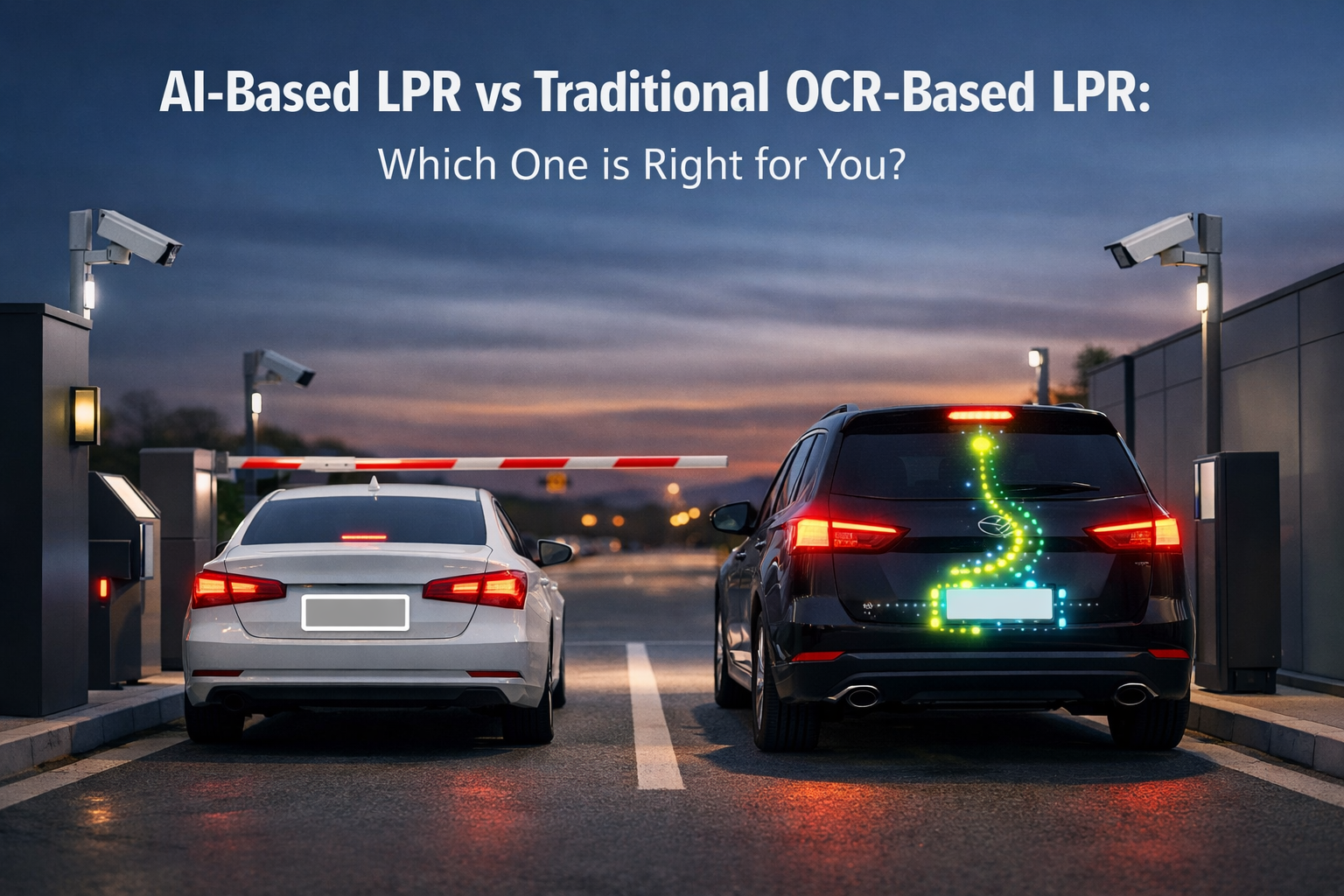
Camera lane comparing AI-based LPR and OCR-based recognition workflows
License plate recognition (LPR), automatic license plate recognition (ALPR), and automatic number plate recognition (ANPR) buyers are no longer choosing only a camera and a database. They are choosing how well their system handles plate variation, bad reads, bandwidth limits, and the cost of acting on the wrong vehicle. This guide compares optical character recognition (OCR)-based LPR with AI-based LPR so your team can choose the right fit.
TL;DR
- Traditional OCR-based LPR works best when plate formats, camera placement, lighting, and traffic lanes stay predictable.
- AI-based LPR is usually the better fit when plates vary, images are messy, or wrong reads create operational cost.
- Accuracy should be judged by the full workflow: plate string, region or state, confidence, image quality, and downstream action.
- Edge LPR and on-premise processing matter when bandwidth, latency, or data-control requirements limit cloud processing.
- The right choice depends less on the label “AI” or “OCR” and more on your plate mix, deployment model, update cadence, and risk tolerance.
Key Takeaways
- OCR-based LPR is a controlled-environment choice; AI-based LPR is a variability-management choice.
- Plate design changes, specialty plates, glare, low light, and occlusion expose brittle recognition assumptions.
- Combined read quality matters more than a single headline accuracy number.
- Edge and on-premise deployment can be as important as the recognition method.
- Vehicle context such as make, model, color, and generation can help teams review uncertain reads.
What is the real difference between AI-based LPR and OCR-based LPR?
Traditional OCR-based LPR starts with a plate image, isolates the plate area, normalizes the characters, and converts those characters into text. The Federal Agencies Digitization Guidelines Initiative defines optical character recognition as converting pixels in a raster image into coded text. In classic LPR, that OCR step is often paired with plate-location logic, image cleanup, and a database lookup.
The National Institute of Justice overview of license plate recognition systems describes older LPR systems as camera, software, and database workflows. A separate OJP/NIJ operational guide says ALPR systems may transform a plate image into alphanumeric characters using OCR or similar software. That definition is useful because it explains why “OCR-based LPR” is not one feature. It is a pipeline.
AI-based LPR changes the center of that pipeline. Instead of depending mainly on character cleanup and fixed recognition logic, AI license plate recognition uses trained models to find plates, read characters, assign confidence, and handle more variation across frames.
For a buyer, the practical question is not whether OCR is old or AI is new. The better question is whether your environment behaves like a clean form scan or a changing road scene.
Key point: The recognition method matters most when the camera scene stops being predictable.
Teams already comparing vendors should start with real plate images, not a demo reel.
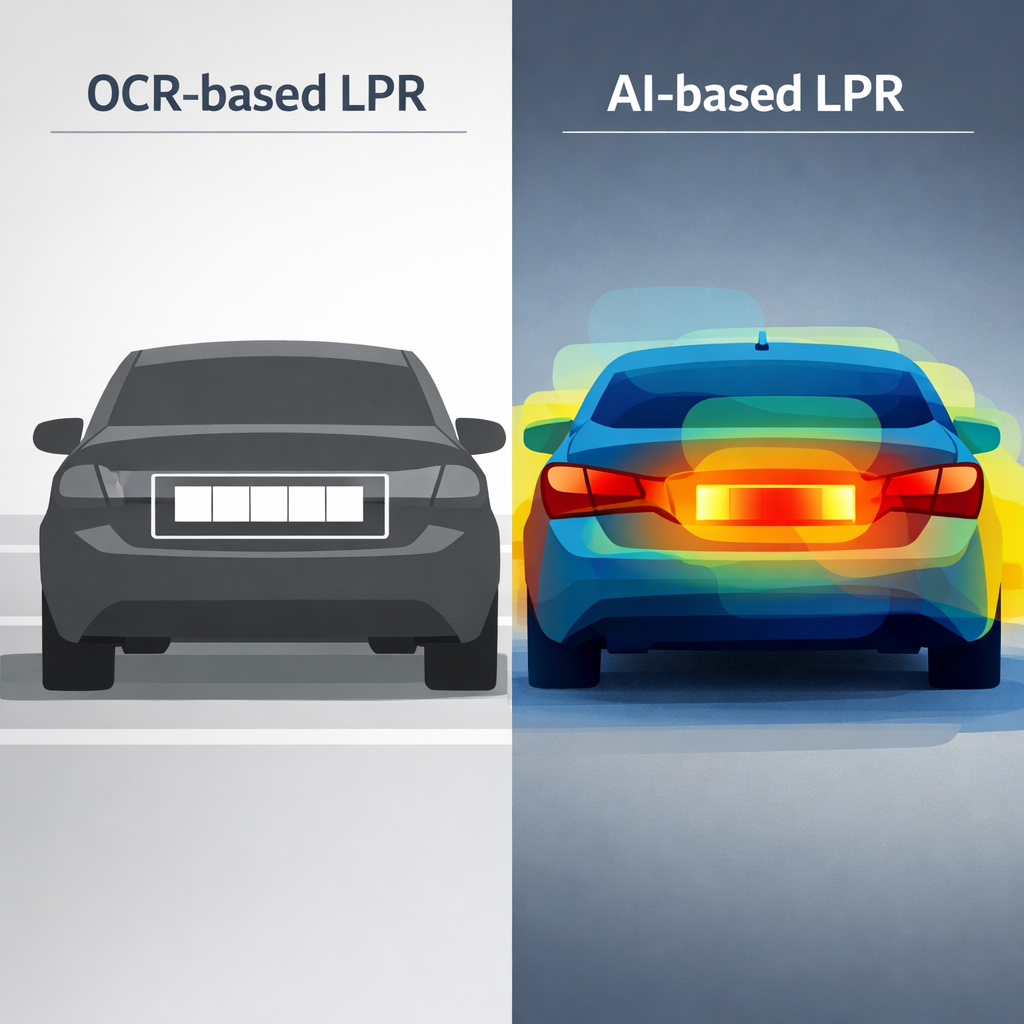
Split diagram comparing OCR templates with AI plate recognition
Where does traditional OCR-based LPR still make sense?
OCR-based LPR can still be a reasonable fit in controlled conditions. A gated lane, fixed camera, consistent plate distance, stable local plate formats, and predictable lighting all reduce the number of variables the recognition engine must handle. In that setting, a traditional OCR LPR system may read enough plates for a narrow workflow.
The tradeoff is tolerance. A site that can accept manual review, occasional missed reads, or a limited plate mix may not need a more advanced system. A small private lot with one entry point has a different risk profile than a citywide camera network, a mobile patrol vehicle, or a service lane where a wrong read can send the wrong workflow to staff.
Teams should also look at what happens after the read. Parking operators may connect LPR to parking and EV workflows. Fleet operators may connect reads to transportation and fleet operations. Public agencies may care about public safety deployments. The narrower the downstream action, the more important it is to know how errors are caught.
A fair buying rule is simple: choose OCR-based LPR only when the environment is controlled and the cost of a bad read is low. Once the site has specialty plates, variable camera angles, fast-moving traffic, or limited review time, the decision should shift toward AI-based LPR.
Where does OCR-based LPR struggle?
OCR-based LPR struggles when the plate stops looking like the template the system expects. Plate formats change. States issue new standard plates, EV plates, specialty plates, commemorative plates, flat plates, and personalized formats. Colorado says its electric vehicle plate became available in 2022. Pennsylvania says a new standard plate style was introduced in 2025. Georgia says a new America 250 standard plate is available in 2026.
Those examples matter because static assumptions age. A system tuned for one state design can stumble on another. Decorative symbols, stacked characters, low-contrast backgrounds, or unfamiliar prefixes can turn into wrong letters. The internal Slack discovery for this piece surfaced the same theme: new plate designs and specialty formats are not edge cases for some operators. They are the daily workload.
OCR-based LPR also struggles when the camera input is poor. Headlights, glare, weather, dirty plates, oblique angles, motion blur, low resolution, and partial occlusion reduce confidence. A traditional pipeline can clean the image, but cleanup cannot recover detail that was never captured. This is why camera placement and plate size still matter, even in an AI-based LPR deployment.
Key point: AI-based LPR can handle more variation, but no recognition system fixes unusable imagery.
A second issue is update speed. When a system depends on brittle rules or slowly updated templates, new plate formats can wait in a vendor queue. For teams planning ALPR accuracy planning, update cadence belongs beside camera selection, not after it.
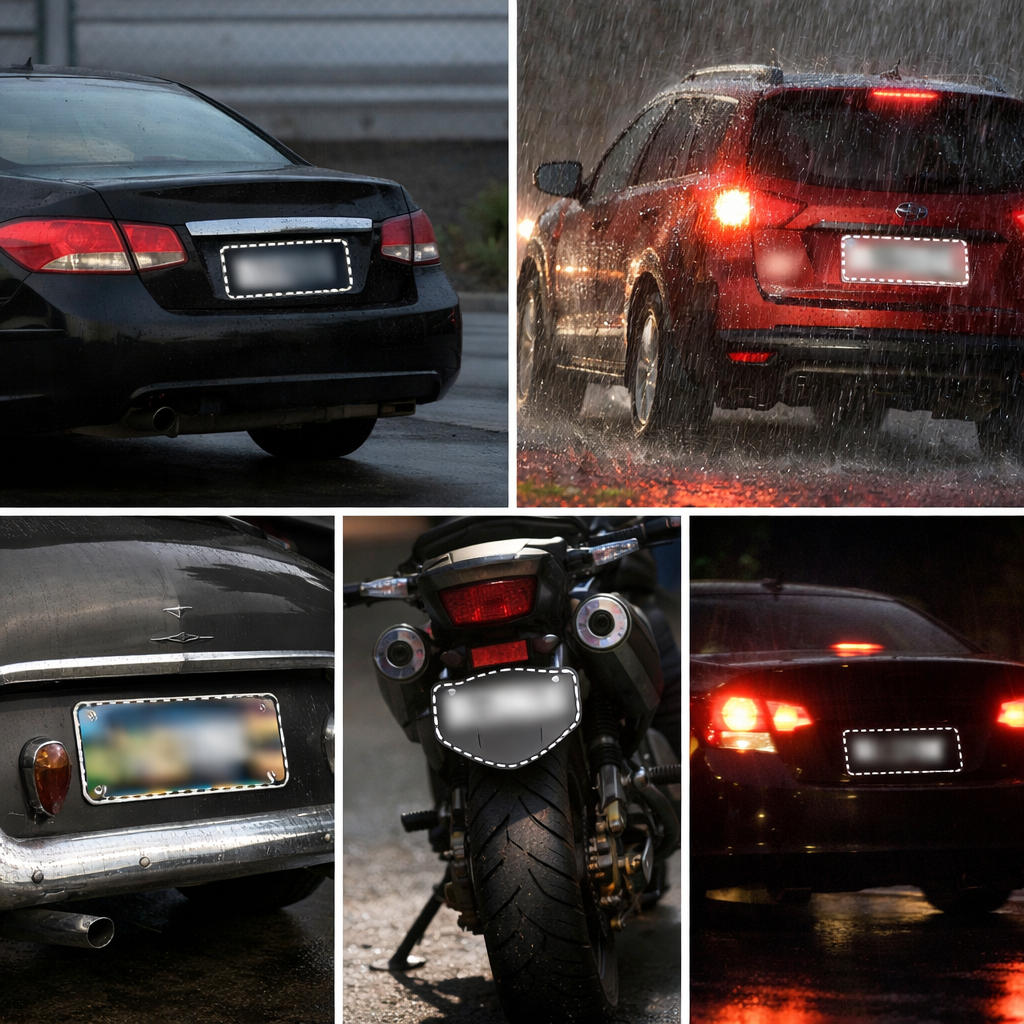
License plates under glare and specialty formats challenge OCR recognition
When is AI-based LPR the better fit?
AI-based LPR is the better fit when the site has real-world variability. That includes mixed plate designs, vehicle speed changes, night reads, glare, weather, specialty plates, partial obstruction, and multiple camera angles. It also includes workflows where a wrong read costs money, blocks a gate, misses a service event, or sends staff to the wrong vehicle.
AI-based systems are also a better fit when the read is part of a broader vehicle identity decision. A plate string is one signal. Vehicle context such as make, model, color, and generation can become a second signal for review.
Deployment is another reason to choose AI-based LPR. Some teams cannot send every frame to the cloud because bandwidth is limited, latency matters, or local data control is required. In those cases, mobile LPR edge computing becomes part of the buying decision, not an add-on.
Sighthound Compute Node ingests RTSP streams from existing network cameras and runs Sighthound's computer-vision stack on top. That matters when your team wants to keep cameras in place while changing the processing layer.
How should you compare LPR accuracy?
Do not ask only, “What is the accuracy number?” Ask what the number measures. A plate-string read is not the same as a full plate plus state or region match. A clean daytime test is not the same as an overnight lane with glare, weather, and uncommon plates. A frame-level read is not the same as a workflow that checks multiple frames, confidence, and vehicle context.
NIST’s AI Risk Management Framework says AI accuracy measurements should use clearly defined, realistic test sets that represent expected conditions. The same NIST page also ties reliability to whether a system performs as required under stated conditions. That is the right frame for ALPR accuracy. An evaluation set should match the site’s camera positions, plate mix, lighting, speeds, and action thresholds.
NIST’s Measure playbook also recommends selecting metrics that show whether a system is fit for purpose and functioning as claimed. For LPR, that means measuring the read that your workflow actually needs. Parking enforcement may need plate plus jurisdiction. Access control may need fast confidence decisions. Fleet or service operations may need the right vehicle record at the right bay.
Key point: Judge LPR accuracy by the decision it triggers, not only by character recognition.
Sighthound ALPR+ reaches above 90% accuracy in almost all real-world scenarios; if a human can read the plate in the frame, ALPR+ can too. Sighthound ALPR+ processes up to 160 FPS on GPU. Those facts are useful, but your procurement test should still use your own footage and acceptance rules.
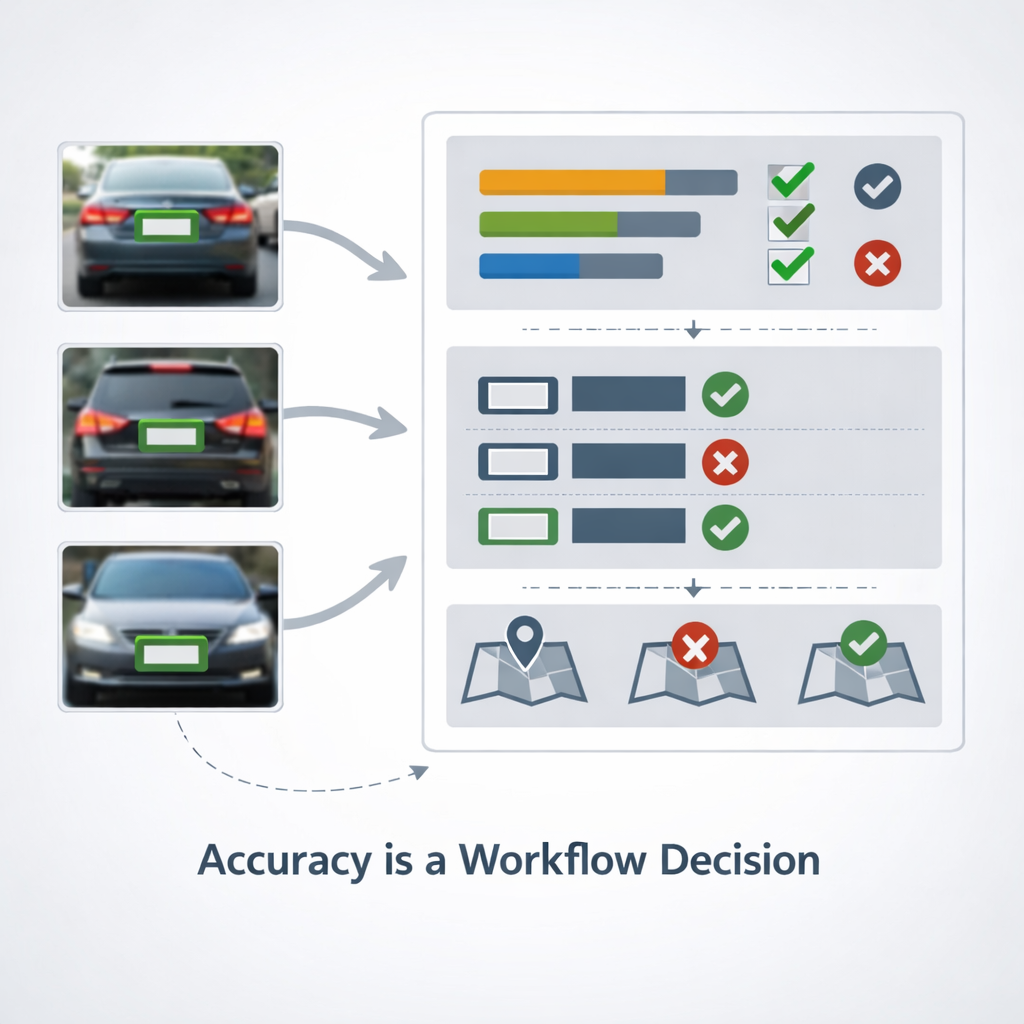
Dashboard concept showing plate string confidence and region checks
What deployment model do you need?
The deployment model often decides the architecture. A cloud-heavy workflow may be fine when bandwidth is available, latency is acceptable, and policy allows image transfer. Edge LPR or on-premise LPR may be better when reads need to happen near the camera, when upstream bandwidth is limited, or when the organization wants tighter control over what leaves the site.
Sighthound ALPR+ runs on Windows 10+, Linux (kernel 5.x+), and embedded Linux and is hardware-agnostic across GPU, CPU, edge, and cloud. Sighthound supports REST APIs, Docker deployments, and pipeline-based workflows. Those deployment facts matter when the reader has existing cameras, a vehicle system, a parking platform, or an internal dashboard.
Sighthound Cloud API and SDK provide developer-facing computer-vision APIs covering LPR, vehicle analytics, and detection primitives. The Sighthound Developer Portal at dev.sighthound.com hosts API, SDK, Agent Toolkit, and integration examples. Sighthound ALPR+ supports license plate region identification for US, Canada, and EU formats.
If your team is comparing edge and cloud options, write down the practical constraints first. How many cameras are active? What frame rate matters? What data must be stored? What can be discarded? Who reviews low-confidence reads? Which system receives the final plate event? These answers matter as much as the recognition model.
How Sighthound ALPR+ helps
Sighthound ALPR+ is AI-powered software for license plate recognition with vehicle make, model, color, and generation (MMCG) analytics and be on the lookout alerts. That makes it a fit for teams that need vehicle intelligence, not only a plate string.
Sighthound ALPR+ audience includes law enforcement, parking operators, toll authorities, fleet operators, smart-city operators, transit agencies, and enterprise security. Sighthound serves Parking and EV with ALPR+ and Compute. Sighthound serves Transportation, Logistics, and Fleet with ALPR+ and Compute.
For buyers, the value is the combination: AI-based recognition, vehicle context, local or cloud deployment options, and integration paths. For local processing, see the page on hardware options.
Comparison at a glance
AI-based LPR is the better fit for variable conditions; OCR-based LPR is the narrower fit for controlled lanes and stable plate formats. Use the criteria below to compare the trade-offs.
| Decision factor | Traditional OCR-based LPR | AI-based LPR |
|---|---|---|
| Best environment | Controlled lanes and stable plate formats | Variable scenes, plate formats, lighting, and traffic |
| Plate variation | More sensitive to templates and character assumptions | Better suited to training on varied examples |
| Accuracy review | Often centered on character output | Should include plate, region, confidence, and workflow fit |
| Deployment | Often fixed around the vendor architecture | Can support edge, on-premise, cloud, or hybrid designs depending on product |
| Update needs | Can lag when new formats appear | Can adapt through model updates and training data when supported |
| Buyer question | “Will it read this known plate format?” | “Will it keep working as conditions change?” |
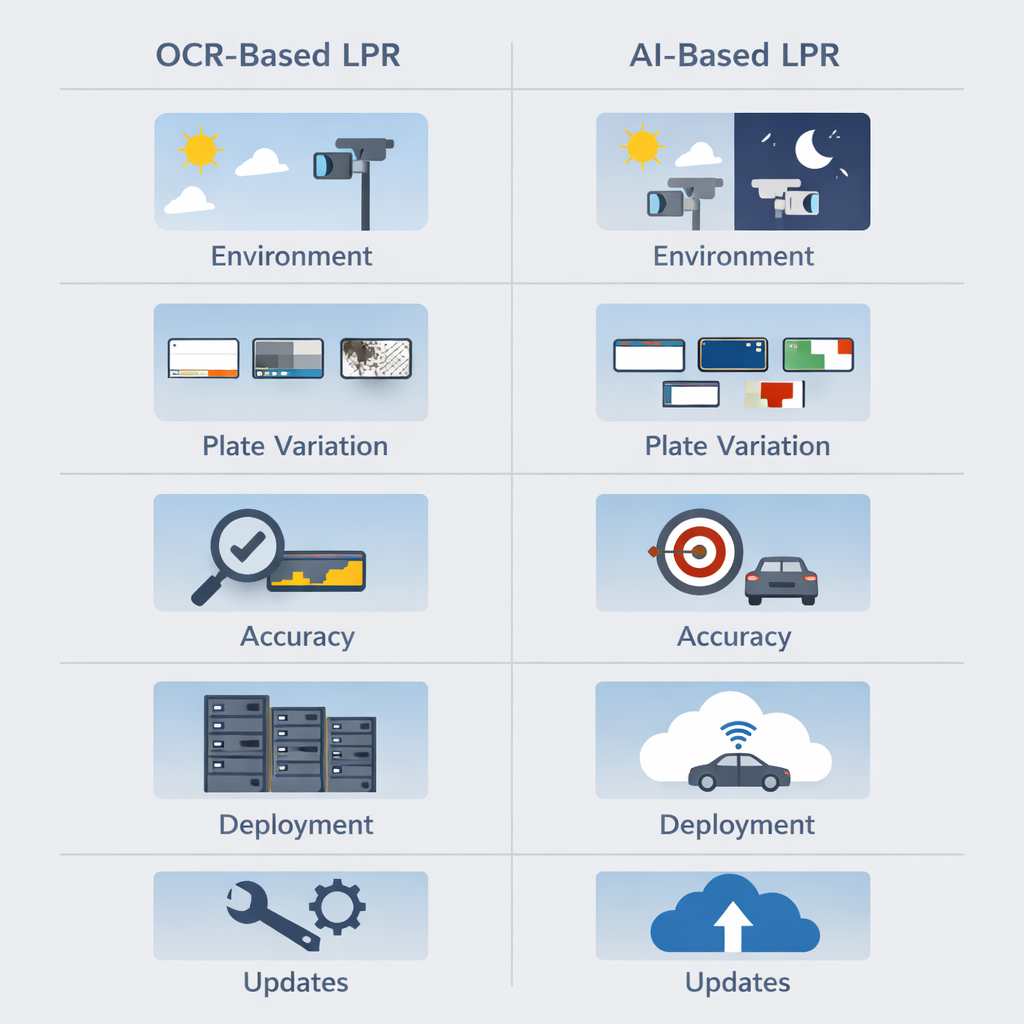
Decision matrix comparing OCR-based LPR and AI-based LPR choices
When should you choose which?
Choose traditional OCR-based LPR when your site is controlled, your plate formats are stable, and your workflow can tolerate occasional review. It can still be practical for a narrow gate, a fixed lane, or a small site where the read is helpful but not mission-critical.
Choose AI-based LPR when your environment is mixed, your plate formats change, or the wrong read has direct cost. That includes parking operations, public safety, access control, fleet yards, smart-city corridors, and service workflows where a plate event drives action.
The safest buying process is a field test. Use your cameras, your night conditions, your state mix, your specialty plates, and your downstream workflow. If the system must work with low bandwidth or local data rules, test edge or on-premise processing from the start.
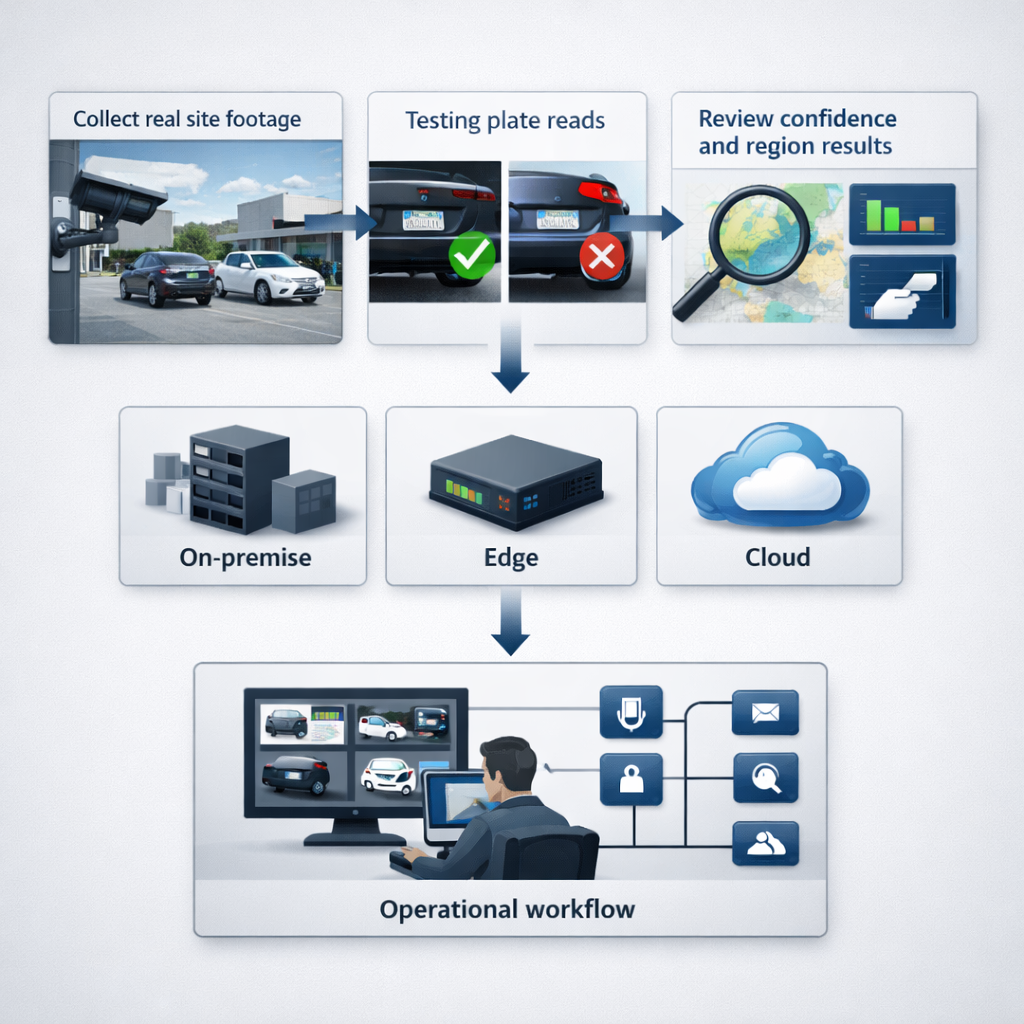
Field test workflow for choosing an LPR deployment model
Legal Disclaimer
This post is informational and not legal advice. LPR, ALPR, ANPR, data retention, access control, and public safety workflows may be subject to local rules, contracts, policies, or regulations. Consult qualified counsel and your internal policy owners before deploying or changing a vehicle-recognition workflow.
Sources
- Sighthound ALPR+
- National Institute of Justice LPR systems overview
- OJP/NIJ ALPR operational guide
- Federal Agencies Digitization Guidelines Initiative OCR glossary
- NIST AI Risk Management Framework trustworthiness characteristics
FAQ
Is AI-based LPR always more accurate than OCR-based LPR?
No. AI-based LPR is usually stronger when conditions vary, but accuracy still depends on camera position, image quality, lighting, plate size, occlusion, training data, and the metric being measured.
What is the biggest weakness of traditional OCR-based LPR?
Its weakness is brittleness. OCR-based LPR can work in controlled settings, but unfamiliar plate designs, specialty plates, symbols, glare, and poor imagery can reduce read quality.
Should I compare accuracy with my own footage?
Yes. Use your own cameras, lighting, speeds, plate mix, and decision thresholds. A vendor test set may not match your deployment conditions.
Does edge LPR mean the system never uses the cloud?
Not always. Edge processing means work happens near the camera or site. Some deployments still use cloud dashboards, APIs, or storage depending on architecture and policy.
What does MMCG add to LPR?
Make, model, color, and generation adds vehicle context. That context can help reviewers reason about uncertain plate reads and connect recognition to vehicle-level workflows.
Related reading
- ALPR, ANPR, and LPR terminology
- ALPR accuracy planning
- vehicle classification models
- mobile LPR edge computing
- Sighthound Developer Portal
What to do next
If your team needs AI-based LPR for variable plates, edge processing, or vehicle-level context, See ALPR+ in action.